Search This Blog

Friday, August 20, 2010

Meet The YouTube Stars Making $100,000 Plus Per Year

Provided by the Business Insider, August 19, 2010:

There are 10 independent YouTube stars who made over $100,000 in the past year, according to a study done by analytics and advertising company TubeMogul.

From July 2009 to July 2010, TubeMogul used their viewership data to estimate the annual income for independent YouTube partners, which they define as anyone who is not part of a media company or brand.

Here's how they got their estimates:

* Revenue only comes from banner ads served near content (we ignored pre-roll or overlay since we can't easily isolate by publisher).
* Since YouTube banner ads have a two-second load delay, we estimate 2.59% of viewers click away before an ad loads based on separate research.
* Ads were served near all videos that loaded (since there are partners, this is generally true).
* CPM for the banner ads was $1.50 (Google auctions a lot of this inventory off; we rounded this 2009 estimate down to be conservative).
* YouTube is splitting ad revenue with partners 50-50.

Basically, take their views from the past year, assume a few don't stick around long enough for an ad to load, divide that number by 1,000, multiply by $1.50 and divide that number in half.

Conservative estimates? Sure. But with that math, you get a pretty decent estimate of how much these YouTube celebrities are making from just the banner ads on their channel. So, without further ado, here are the highest earning YouTube stars!

1. Shane Dawson – $315,000

Shane Dawson is so popular that he is three different YouTube channels. His most popular channel consists of his comedy skits and music video parodies. Dawson created a second channel as a vlog and for a separate series called "Ask Shane," and his third channel only has videos taken from his iPhone.

July 2009 - 2010 Views: 431,787,450

2. The Annoying Orange – $288,000

The Annoying Orange is a comedy web series that takes place in a kitchen and is about talking fruit. Dane Boedigheimer is the mastermind behind the series and is also the voice of Orange.

July 2009 - 2010 Views: 349,753,047

3. Philip DeFranco – $181,000

Philip DeFranco uploads a new video onto YouTube every Monday to Thursday for his show – The Philip DeFranco Show. His video blogging topics range from politics to pop culture.

July 2009 - 2010 Views: 248,735,032

4. Ryan Higa – $151,000

Ryan Higa makes comedy skits and is a video blogger who turned into a viral star with his "How to be Gangster" and "How to be Ninja" videos. Even though he doesn't upload as many videos as his fellow YouTube celebrities, Higa is still the top dog at YouTube with over 2.6 million subscribers.
July 2009 - 2010 Views: 206,979,909

5. Fred – $146,000

Lucas Cruikshank plays "a lonely six year old named Fred" who uses his mom's video camera and posts videos on a YouTube channel. As the second most subscribed to YouTube channel, Lucas Cruikshank's immensely popular Fred character even has a movie coming out backed by Nickelodeon.

July 2009 - 2010 Views: 200,656,150

6. Shay Carl – $140,000

As a radio DJ, Shay Carl started making comedy skits and put them on YouTube for the world to see. He claims to have held 20 different jobs before settling down with his DJ and YouTube gigs.

July 2009 - 2010 Views: 192,309,247

7. Mediocre Films – $116,000

Greg Benson created Mediocre Films initially for a sketchy comedy TV series called "Skip TV." The show lasted for one season, and now Benson makes low budget comedy videos for the web.

July 2009 - 2010 Views: 159,030,703

8. Smosh – $113,000

Smosh is the comedy duo of Ian Hecox and Anthony Padilla, and with over 1.7 million subscribers, they make up the 5th most popular channel on YouTube. They first shot to viral fame with their "Pokemon Theme Music Video" which became YouTube's most viewed video in Spring 2006. However, due to copyright reasons, the original video was removed from YouTube.

July 2009 - 2010 Views: 154,936,876

9. The Young Turks – $112,000

The Young Turks is a political talk show that also airs on Sirius Satellite Radio. Founded and hosted by Cenk Uygur, The Young Turks talk show and their vast viewership has proven that the Internet can be a viable broadcast platform.
July 2009 - 2010 Views: 153,807,362

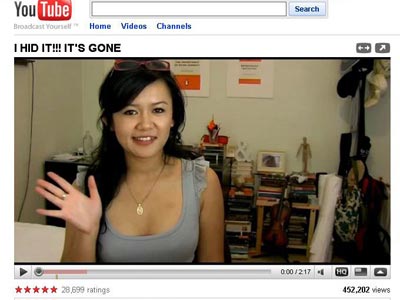
10. Natalie Tran– $101,000

Under the user name of communitychannel, Natalie Tran is the most subscribed to YouTube user in Australia. Like most others on this list, she is a video blogger and occasionally uploads comedy skits.

July 2009 - 2010 Views: 138,871,829

Thursday, August 19, 2010

France sends Roma Gypsies back to Romania

Christian Fraser visits a French Roma (Gypsy) camp

Dozens of Roma (Gypsies) have arrived back in Romania after being repatriated by France under a controversial policy backed by President Nicolas Sarkozy.

At least 70 Roma left France and hundreds more will follow in the coming weeks after their camps were shut down.

The French government says it is a "decent and humane" policy of removing people from deplorable conditions.

But rights groups say the Roma are being demonised, and Romania has warned France against "xenophobic reactions".

"We understand the position of the French government. At the same time, we support unconditionally the right of every Romanian citizen to travel without restrictions within the EU," Romanian President Traian Basescu said.

However, Mr Basescu added that he was prepared to send police to France to help implement the repatriation scheme.

Two flights from Lyon and Paris were due to be carrying 93 Roma passengers, but according to some reports only 70 actually boarded the flights and arrived in Bucharest.

A deportee named Gabriel told the AFP news agency in Bucharest that life had been "very tough" in France, but he would not rule out returning because there was no work in Romania.

Another man said that in Romania "we don't have any chance, no jobs, nothing".

Hundreds more are expected to leave France on flights scheduled for Friday and next week.

Exploitation claims

The Roma are EU citizens, mostly from Romania or Bulgaria, but French law requires them to have a work permit and prove they have the means to support themselves if they intend to stay for more than three months.

“Start Quote

The Roma have a history of being persecuted - many were killed by the Nazis”

They complain that the permits are difficult to get, and so they are often forced to live illegally.

Roma who agree to leave have each receive 300 euros (£246; $384) and an additional 100 euros for each child.

The French government says it plans to shut down 300 illegal Roma camps in the next three months.

The controversial plan was put in place after clashes last month between police and travellers in the southern city of Grenoble and the central town of Saint-Aignan.

The Roma were not involved in all of the trouble, but the government said travellers' camps were sources of "illegal trafficking" and "exploitation of children for begging, of prostitution and crime".

Some 51 camps have already been demolished by police and the residents have been moved into temporary shelters or accommodation.

Popularity booster?

The operation has been condemned by human rights groups, who say it is deliberately stigmatising a generally law-abiding section of society to win support among right-wing voters.

France's Roma

Roma families arriving at Bucharest airport, 19/08
  • Roughly 12,000 Roma migrated to France after Bulgaria and Romania's accession to the EU
  • Many have no work permits, so live in camps and resort to begging
  • Separately, at least 400,000 people are designated "travellers", mostly French nationals with Roma origins

Last week, members of the UN's Committee on the Elimination of Racial Discrimination criticised the tone of political discourse in France on race issues, saying racism and xenophobia were undergoing a "significant resurgence" there.

But France has insisted that the actions "fully conform with European rules and do not in any way affect the freedom of movement for EU citizens, as defined by treaties".

Foreign ministry spokesman Bernard Valero told AFP that an EU directive "expressly allows for restrictions on the right to move freely for reasons of public order, public security and public health".

The European Commission said it would ensure none of the bloc's rules were being broken.

France repatriated some 10,000 Roma last year and other European countries, including Germany, Italy, Denmark and Sweden pursued similar policies.

Mr Sarkozy's political opponents have accused him of using the Roma issue to shift public attention away from corruption and on to crime.

The BBC's Christian Fraser in Paris says that the president's poll rating is sagging and there are some who accuse him of using the recent unrest to boost his own popularity.

Some of the Roma living in France are part of long-established communities of travelling people who are French nationals.

In addition, there are an estimated 12,000 Roma who are recent immigrants from Central Europe.

"Some of these families have been in France for five, seven or 10 years and 300 euros is not enough to help them settle in Romania. They will return in the coming weeks," Malik Salemkour, the vice-president of the French Human Rights League, told the Reuters news agency.

World Cup boosts TV viewing figures

Andres Iniesta celebrates scoring his World Cup winner for Spain
The World Cup and the economic downturn contributed to the boost, Thinkbox said

The World Cup contributed to a rise in the number of hours people spent watching TV in the first six months of the year, according to research.

Broadcasters' Audience Research Board (Barb) data suggests that, in the year to June, viewers watched an average of 28 hours and 15 minutes each week.

That is up 48 minutes on the same period last year.

Commercial TV marketing body Thinkbox said the rise could also be attributed to more Britons staying at home.

It suggested people were staying in because of the economic downturn - and were tempted to watch more TV because of the increased choice in channels as more households went digital.

The findings were reinforced by financial results from cinema chain Cineworld, which reported a 3% fall in admissions in the first half of the year.

Thinkbox chief executive Tess Alps said new ways of measuring viewing - which more accurately captured second TV sets and watching on-demand - had also been introduced.

"We know that technology is also making TV ever more attractive and we should never underestimate the fundamental importance of compelling content," she added.

'Lack of variety'

The figures, published in Thinkbox's half-year viewing review, only include shows watched on TV sets, which were viewed live or within seven days of broadcast.

The data suggests that commercial TV accounted for 62% of viewing.

Recorded programmes and on-demand services accounted for 7.1% of all TV watched in the UK while 80.4% of "time-shifted" viewing took place within a week of original broadcast.

Meanwhile, a report by media regulator Ofcom suggests that more than half of people aged 65 and over think TV programmes have become worse.

Ofcom interviewed 2,044 adults between April and October 2009.

Of those adults who thought TV had got worse in the past year, 65% cited an increase in the number of repeats as a reason.

A third of of those who thought it had deteriorated cited "lack of variety".

The report also suggest that people in the UK spend seven hours a day watching TV, surfing the net and using their mobile phones.

Growing number in America believe Obama a Muslim - poll

Barack Obama Mr Obama, a Christian, celebrated Ramadan with Muslim Americans and foreign dignitaries this month

A growing number of Americans incorrectly believe President Barack Obama is a Muslim, research suggests.

Some 18% said the president was a Muslim, up from 11% in March 2009, according to the Pew Research survey of 3,003 Americans.

Among Republicans, that number was 34%. Just a third of those quizzed correctly identified Mr Obama as Christian.

Polling was done before 13 August when Mr Obama defended Muslims' right to build an Islamic centre by Ground Zero.

Forty-three per cent of those questioned said they did not know what Mr Obama's religion was.

'Spreading falsehoods'

The White House attributed the mistaken beliefs about Mr Obama's religion to a "misinformation campaign" pursued by his political opponents.

"While the president has been diligent and personally committed to his own Christian faith, there's certainly folks who are intent on spreading falsehoods about the president and his values and beliefs," White House faith adviser Joshua DuBois told AFP news agency.

The poll found beliefs about the president's faith were closely linked to political judgments about him.

It found that people who believe Mr Obama is a Muslim "overwhelmingly disapprove" of his job performance, while a majority of those who identify him as a Christian approve.

Graph: Growing belief that President Barack Obama is a Muslim, based on Pew Research Centre poll

News of the poll comes amid fears by some US Muslims that they will be targeted due to the fact that the holiday of Eid falls on 11 September this year, the anniversary of the terror attacks of 2001.

Some are concerned that the joyous festivals that mark the occasion will be mis

construed as celebrations of the attacks.

Meanwhile a national debate continues over a developer's plans to build a mosque and community centre two blocks away from Ground Zero in New York.

The plans have provoked vehement opposition from many conservatives, though Mr Obama, New York Mayor Michael Bloomberg, the chairman of the US Democratic party and others have defended the developers' right to build there.

Cameron Diaz ranked most dangerous Web celeb: study


Story photo: Cameron Diaz ranked most dangerous Web celeb: study
McAfee names Cameron Diaz 'Most Dangerous Celebrity in Cyberspace' (Photo: Business Wire)
Reuters


NEW YORK (Reuters) - She may be known for her playful giggles and killer looks, but now movie star Cameron Diaz has become the most dangerous celebrity on the Internet.

Diaz, 37, is top of the list of the most dangerous celebrities to search for online, above second-placed Julia Roberts, according to computer security company McAfee, Inc. Last year's most dangerous Web celebrity, Jessica Biel, fell to third.

One in ten websites featuring the "Knight and Day" star contain malicious software intended to infect computers and steal data from users, according to research released on Thursday by McAfee.

Creators of malicious software use celebrities as lures, baiting fans and followers to click on and download seemingly innocuous content containing programs designed to steal passwords and other private information for profit, said Dave Marcus, director of security research at McAfee Labs.

"They know that people want to have screensavers of popular individuals. They follow hot topics on the Web and create their poisonous content accordingly," Marcus said.

"This relates to a larger trend of using social engineering lures. A lot of times a cyber criminal will mine Twitter, or follow Google Trends, to poison those links. It's very clear they will use news trends to lure," he said.

Supermodel Gisele Bundchen came in at fourth, followed by Brad Pitt, one of only two men to be listed in the top ten.

"Brad Pitt is historically one of the most dangerous celebrities to search on," said Marcus. "He's always up there."

Former Victoria's Secret model Adriana Lima came in sixth, followed by Jennifer Love-Hewitt and Nicole Kidman, who tied for seventh. Tom Cruise ranked eighth, and Heidi Klum and Penelope Cruz tied for ninth. Anna Paquin, the star of TV hit "True Blood", rounded out the top ten.

This is the fourth time McAfee published the annual list of dangerous individuals.

Marcus said he's seeing the same types of malicious software being distributed, but in higher numbers. "We tracked more malware in the second quarter of 2010 than ever before," Marcus said.

McAfee found 6 million unique, newly created pieces of malicious programing. "That's about 60,000 pieces per day. It's a big, honkin, onerous number," he said.

The study used McAfee's SiteAdvisor ratings to track risky sources of celebrity content on the Web, and used these results to calculate an overall risk percentage.

Hacker explains why he reported 'Wikileaks source'

So news that former high-profile hacker Adrian Lamo had turned over an Army intelligence analyst to authorities was met with derision by some.

"A lot of people have labelled me a snitch," Mr Lamo told BBC News. "I guess I deserve that on this one but not as a generality."

"This was a very hard decision for me."

Mr Lamo is a former hacker, who exposed security flaws at the New York Times, Yahoo and Microsoft. After a brief stint hiding from the FBI, Mr Lamo was imprisoned and fined. He now works as a journalist and security analyst.

'By the book'

Mr Lamo says that he was responsible for reporting Specialist (SPC) Brad Manning to the military authorities after the analyst boasted to him that he had handed over thousands of classified documents and classified military video to whistle-blower site Wikileaks.

One video posted to the site shows a US Apache helicopter killing up to 12 people - including two Reuters journalists - during an attack in Baghdad in 2007. Two children were also seriously injured in the attack. Some of the men were armed.

Mr Manning, 22, reportedly acquired the video during the course of his work at a US Military field base FOB Hammer, on the outskirts of Baghdad.

“Start Quote

I didn't want any more FBI agents knocking at the door”

End Quote Adrian Lamo

Mr Lamo said that he did not suspect anything unusual when Mr Manning contacted him over instant messenger and e-mail.

"I'm contacted on a daily basis by all kinds of people who confess to all kinds of federal crimes," he said.

"I have never once turned them in, even when the FBI offered me a deal."

However, after Mr Manning confessed to distributing the documents, Mr Lamo said that his stance changed and he "felt the need to contact investigators".

"At the moment he gave me the information, it was basically a suicide pact."

"I was worried for my family - that if I were obstructing justice that they could be caught up in any investigation," he said.

"I wanted to do this one by the book, by the numbers. I didn't want any more FBI agents knocking at the door."

Code words

Mr Lamo also said that he had decided to report Mr Manning for reasons of national security.

Instead of going straight to the authorities, Mr Lamo disclosed the information to "a friend" who had worked as an agent in the Army counter intelligence unit.

"He put me in touch with some of his former colleagues who he felt could handle the issue in a low key way," he said.

Wikileaks logo

Four agents - from different federal and military agencies - turned up at his house to read the conversation logs - from his e-mail and instant messenger conversations with Mr Manning - "one by one", he added.

"I gave them conversation logs that implicated Special Agent Manning.

"They were particularly interested in a code word for a major operation."

Mr Lamo also described how Mr Manning had supposedly obtained the documents.

"He described the process of operational security in detail," said Mr Lamo.

"What he described was a culture of insecurity with poor attention to information.

"The field base didn't have significant security."

'Impossible decision'

He said that Mr Manning would download the documents from a room that needed a unique security code to access it. However, security on the base had slipped, he said.

"He said you'd knock on the door and they'd let you in."

Mr Lamo said that Mr Manning would take a CD labelled Lady Gaga into the room which he would load into a computer.

“Start Quote

I want to be proud of it but I can't bring myself to be”

End Quote Adrian Lamo

"Basically he sat down and started burning data to the CD whilst pretending to be bopping along."

Mr Manning would then upload the documents to Wikileaks servers, which are held in various countries around the world and anonymise the source.

Wikileaks has not confirmed Mr Manning as the source of the video and has said it never collects personal information on sources. It said that it has not been sent 260,000 classified US embassy cables that Mr Manning reportedly leaked to the site.

Wikileaks also questions Mr Lamo's credibility.

However, the US military has confirmed that Mr Manning has been detained on suspicion of leaking classified documents and video. He is being held "in pre-trial confinement" in Kuwait.

"I want to be proud of it but I can't bring myself to be. I keep thinking about what it was like being 22, alone and not knowing about my future," said Mr Lamo.

"Knowing that I did that to somebody - it hurts. I feel like I should be talking to a priest."

He said he had been placed in a situation where "an impossible decision had to be made".

"I hope that Manning gets the same chance as I did - the same chance to take his punishment as I did and start a new life as I did."

"I like to think I prevented him from getting into more serious trouble."

Wikileaks encryption use offers 'legal challenge'

Wikileaks co-founder Julian Assange responds to a BBC question about why it provides encrypted files for download. (Video: Frontline Club)

A novel use of encryption by whistle-blowing website Wikileaks could "challenge the legal system for years to come," according to an influential observer of the hacking community.

Emmanuel Goldstein, editor of 2600 The Hacker Quarterly magazine, made his comments in reference to an encrypted file recently posted on the site.

Some suspect the file - as yet unopened - contains further sensitive material.

It has been reposted around the web and is available for anyone to download.

"If you release it in encrypted form, nobody really knows if you've released it or not - or even what the material is," Mr Goldstein told BBC News.

"Then, if something happens to you, all it takes is the revelation of a simple spoken phrase known by a select group of people and everyone who has this mystery file now has all of the secrets."

'Uncrackable file'

Wikileaks recently published 76,000 secret US military logs detailing military actions in Afghanistan; an act the US authorities described as highly irresponsible.

The website now says it will release 15,000 further sensitive documents, once it has completed a review aimed at minimising the risk that the release could put people's lives in danger.

The site came under criticism after it released the first tranche for endangering the lives of informants or others named in the documents.

The release of the logs has led many to wonder what action the US might take against Wikileaks.

Now it seems the site may be using encryption as insurance against legal and other threats to the information it holds.

The insurance.aes256 file has been posted alongside the already published leaked war logs and can be downloaded by anyone.

Leaked video of July 2007 helicopter attack in Baghdad Some have speculated that the insurance file is another video

From the file name, it is believed that it has been encrypted using the AES256 algorithm - described as "extremely strong" by Professor Whitfield Diffie, of the Information Security Group at Royal Holloway University, London.

Prof Diffie believes that AES256, which he says has been "extensively studied" could prove too tough even for US intelligence agencies to break.

While no-one knows what the insurance file contains, this has not prevented the contents becoming a matter of considerable speculation.

Some suspect that the file contains a further leaked US military video, others that it is another tranche of US military logs - perhaps this time from Iraq. Or it could just be an imaginative bluff.

Even the name of the directory in which it is held - "straw-glass-and-bottle" - has prompted discussion and debate online.

'Historical value'

Speaking at a recent event at London's Frontline Club, Wikileaks founder Julian Assange told attendees how the use of encryption could help overcome legal efforts to prevent publication.

“Start Quote

In a sense communications networks can be defined entirely by who has cryptographic keys and I think a lot of networks will work that way in the future”

End Quote Prof Whitfield Diffie Information Security Group

Mr Assange told the BBC that Wikileaks had often distributed encrypted material among its members in order to protect it.

"We have over a long period of time distributed encrypted backups of material we have yet to release," he told the gathering.

"All we have to do is release the password to that material and it is instantly available," he said.

By publishing the encrypted documents publicly, Mr Assange said Wikileaks was protecting material of historical value.

"That duty to history is something that weighs heavily with us. If you had the Stasi archive in your pocket, that is a very heavy pocket indeed," he said.

"We take precautions to make sure that sort of material is not going to disappear from history regardless of the sort of threats to this organisation."

Intelligence test

But with the "insurance file" Wikileaks has taken the unusual step of making an encrypted backup - if that is indeed what it is - publicly available online.

Emanuel Goldstein told the BBC: "Julian is smart. He always has a backup, which is the rule of thumb in this community."

But he believes this goes further than just a need to preserve information.

Wikileaks logo Wikileaks has come under criticism for its most recent leaks

"It's a fascinating tactic and one which will challenge the legal system for years to come."

In Mr Goldstein's view, any attempt now to seize or prevent publication of material held by Wikileaks will be self-defeating because thousands of copies will already have been distributed world wide.

It is, he says, "a tactic of intelligence to ward off the inevitable clampdown."

But Cindy Cohn, legal director of the Electronic Frontier Foundation is less convinced the file represents a challenge to the US government.

"I don't see it as a challenge, as much as being open about what's going on," she told the BBC.

In Ms Cohn's view the idea of circulating encrypted copies of information to keep it safe is well-established.

The tactic, according to Ms Cohn, has been used in the past by human rights groups and other organisations.

She points to projects like Freenet, which use encryption and wide distribution of data to resist censorship.

"Wikileaks is doing the same basic thing in a more directly political context and using encryption to allow them to be more open about it on the front end."

For Prof Diffie, the release of information in this way does open up interesting possibilities.

"In a sense communications networks can be defined entirely by who has cryptographic keys, and I think a lot of networks will work that way in the future."

That's a view which will not be good news for those trying to prevent groups sharing and publishing leaked material.

"I think that the people who are trying to shut down Wikileaks are going to have to accept this as a fact of reality that cryptography allows you to do this kind of thing," Prof Diffie said.