Search This Blog

Showing posts with label Canada. Show all posts

Monday, August 15, 2011

Hilary Duff Is Pregnant With First Child!

Story photo: Hilary Duff Is Pregnant With First Child!

Hilary Duff's first wedding anniversary is extra sweet: she and Mike Comrie announced they are expecting a baby!

"This weekend, Mike and I are celebrating our one year anniversary! In memory of the special day, we decided to post some of our favorite pictures from our wedding!" she wrote on her official website Sunday.

"I can't believe it has already been a year. Time really flies when you're having fun! We also want to share the exciting news that baby makes three! We are extremely happy and ready to start this new chapter of our lives. Thanks to everyone for the continued love and support throughout the years!"

Duff, 23, wed pro hockey player Comrie, 30, on August 14, 2010 in an intimate sunset ceremony at a $29 million estate near the San Ysidro Ranch in Montecito, Calif.

"We both love kids and we're really excited," Duff told Us Weekly Wednesday at the Kendra Scott jewelry event in L.A., just days before sharing her pregnancy news with the world. "It was a big deal for us because we had a year to be married."

Saturday, July 16, 2011

Wreck of Canadian schooner found in Lake Ontario

ROCHESTER, N.Y. (AP) — After 105 years, the three masts of the Queen of the Lakes still stand erect — all the more remarkable because the 19th-century Canadian schooner has sat in the dark depths of Lake Ontario since it wrecked in 1906.

"We think it hit bow first because the bowsprit is broken off, but the rest of the ship looks pretty nice," undersea explorer Jim Kennard said Friday.

Kennard and fellow shipwreck enthusiasts Dan Scoville and Roland Stevens located the 129-foot-long vessel using side-scan sonar in 2009. They confirmed the find and captured images of it in early July using a remotely operated submersible.

Loaded with 480 tons of coal, the 53-year-old ship ran into a stiff gale in November 1906, sprung a leak and sank rapidly some 10 miles off Sodus Bay on the lake's southern shore. The crew of six clambered aboard a yawl and rowed to safety.

The ship sits on the lake bed at a depth of 200 to 300 feet. Its masts extend as much as 100 feet upward in calm, frigid waters deprived of oxygen, conditions that account for how well it's preserved.

"When you have a temperature of, like, 39 degrees and you're at a depth where there's no wave action or current, the only thing that can damage the wood would be zebra or quagga mussels as they collect and grow in big clumps and fall off," Kennard said.

The invasive mussels were not introduced to the lake system until the past 15 years or so, he said. "Years ago, all you would see on the ship was just a dusting of silt," he added.

Its rigging and sails have long since disintegrated and the large, tapered spar extending forward from the bow is gone.

But both anchors and the mussel-coated wheel are firmly in place. Cables that held the masts in place lie in coils on the deck and a steam-powered winch that might have been added in the early 1900s is visible in the bow section.

The ship was sailing from Rochester to Kingston, Canada, when it began taking on water.

"I've read the most important item on such ships was the bilge pump," Kennard said. "A vessel that old was pushing its limits. In a Northeast storm, things are really getting jostled around and, all of a sudden, the bottom fell out. The crewmen were only within 50 feet of the boat when it sank. It went down really quickly."

In 2008 in Lake Ontario, Kennard's team located the wreck of the HMS Ontario, the oldest shipwreck ever found in the Great Lakes. During the American Revolution in 1780, the 22-gun British warship was lost in a gale with barely a trace and as many as 130 people aboard.

Since 1970, Kennard has helped find more than 20 wrecks in the Great Lakes and about 180 others in Lake Champlain, New York's Finger Lakes and the Mississippi and Ohio rivers.

Thursday, July 29, 2010

Ship lost for more than 150 years is recovered


TORONTO – Canadian archeologists have found a ship abandoned more than 150 years ago in the quest for the fabled Northwest Passage and which was lost in the search for the doomed expedition of Sir John Franklin, the head of the team said Wednesday.

Marc-Andre Bernier, Parks Canada's head of underwater archaeology, said the HMS Investigator, abandoned in the ice in 1853, was found in shallow water in Mercy Bay along the northern coast of Banks Island in Canada's western Arctic.

"The ship is standing upright in very good condition. It's standing in about 11 meters (36 feet) of water," he said. "This is definitely of the utmost importance. This is the ship that sailed the last leg of the Northwest Passage."

The Investigator was one of many American and British ships sent out to search for the HMS Erebus and the Terror, vessels commanded by Franklin in his ill-fated search for the Northwest Passage in 1845.

Environment Minister Jim Prentice said the British government has been notified that one of their naval shipwrecks has been discovered, as well as the bodies of three sailors.

Captained by Robert McClure, the Investigator sailed in 1850. That year, McClure sailed the Investigator into the strait that now bears his name and realized that he was in the final leg of the Northwest Passage, the sea route across North America.

But before he could sail into the Beaufort Sea, the ship was blocked by pack ice and forced to winter-over in Prince of Wales Strait along the east coast of Banks Island.

The following summer, McClure tried again to sail to the end of the Passage, but was again blocked by ice. He steered the ship and crew into a large bay on the island's north coast he called the Bay of Mercy.

There they were to remain until 1853, when they were rescued by the crew of the HMS Resolute. The Investigator was abandoned.

"This is actually a human history," said Bernier. "Not only a history of the Passage, but the history of a crew of 60 men who had to overwinter three times in the Arctic not knowing if they were going to survive."

The Parks Canada team arrived at Mercy Bay on July 22. Three days later, the ice on the bay cleared enough that researchers were able to deploy side-scanning sonar from a small inflatable boat over the site where they believed the wooden ship had eventually sunk. Within 15 minutes, the Investigator was found.

"The ship had not moved too much from where it was abandoned," said Bernier.

The masts and rigging have long been sheared off by ice and weather. But the icy waters of the McClure Strait has preserved the vessel in remarkably good condition.

"It's incredible," said Prentice from Mercy Bay. "You're actually able to peer down into the water and see not only the outline of the ship but actually the individual timbers.

Archaeologists have also uncovered artifacts on land left behind by the stranded sailors, who unloaded everything before abandoning the Investigator.

The graves of three sailors thought to have died of scurvy have been marked off and will be left undisturbed, said Bernier.

Bernier said the next step will be to send down a remote controlled video camera to get actual pictures of the wreck. There are no plans to bring it to the surface and all legal steps will be taken to ensure the site remains protected.

Bernier also said the team will use similar technology to find the Erebus and Terror.


Copyright: Yahoo News

Thursday, May 13, 2010

World's Most Weird Structures

These odd, eye-popping structures — in England, China, and elsewhere — are worth a detour.

Between all the bubbly novelties that went up in pre-Olympics Beijing, and Dubai’s feverish invention over the past decade, nothing should surprise us. Except that some buildings still do. And these eccentric edifices, breathtaking in their strangeness, are worth a detour—if only to ginger up your worldview a bit.


Selfridges Department Store

Birmingham, England

The Birmingham branch of Selfridges is a billowy mattress of a building, clad in 15,000 shimmery aluminum discs like that famous Paco Rabanne dress. It was designed by Future Systems—the name tells you pretty much everything you need to know about the firm—to be a landmark and a catalyst for the revitalization of a largely moribund city center. “An ersatz urban cliff, a giant sea anemone, a friendly, blob-like alien, the mother of all magic mushrooms,” wrote Guardian architecture critic Jonathan Glancey. “This is the department store as unalloyed architectural entertainment.”

Step Inside: The interior, with floaty white escalators crisscrossing in an open atrium, looks like a scene from Fritz Lang’s Metropolis.

The Bar Code Building, St. Petersburg, Russia
Anton Chmelev
The Bar Code Building

St. Petersburg, Russia


Near the banks of the Neva River, this trade complex by Vitruvius & Sons transforms the world’s most ubiquitous symbol of commerce—the bar code—into a powerful architectural motif. It can be read as an update of American-style roadside classics like the giant Dixie Cup water tower of Lexington, KY, or Detroit’s giant Uniroyal Tire. The rust-red steel building brightens an otherwise bleak urban setting.

Strange Trend: There’s also a Barcode House by the Dutch architecture firm MVRDV on the outskirts of Munich, but it’s much more subtle.

Bioscleave House,East Hampton, N.Y.
Eric Striffler/The New York Times/Redux
Bioscleave House

East Hampton, N.Y.

Husband and wife artists Arakawa and Madeline Gins designed this intentionally unsettling house in 2008. With its bumpy, hilly floors and a wildly asymmetrical plan—even the electrical outlets are at weird angles—it’s supposed to stimulate the immune systems of its occupants by keeping them from ever becoming comfortable. This relentless “tentativeness,” the artists believe, is the key to immortality.

Embrace the Strange: This house can be yours. It’s currently offered by Sotheby’s Realty for $4 million.

Ontario College of Art and Design, Toronto
Richard Johnson
Ontario College of Art and Design

Toronto

This crossword puzzle checked box appears, at a distance, to be hovering Close Encounters–style above an otherwise mundane Toronto neighborhood. As you approach, its improbability only increases. British architect Will Alsop planted this collection of galleries and studio spaces on brightly colored columns so insouciantly angled and skinny that they barely look like they can support themselves.

Nearby Oddity: There goes the neighborhood: Daniel Libeskind’s bizarre 2007 crystalline addition to Toronto’s Royal Ontario Museum is just a mile away.

Ramot Polin Apartments, Jerusalem, Israel
Israel images/Alamy
Ramot Polin Apartments

Jerusalem, Israel

Polish-born architect Zvi Hecker’s experiment in multi-unit residential construction is not as well known as the Habitat housing Moshe Safdie designed for Expo 67 in Montreal, but at 720 units is much larger. It was also an exercise in using prefabricated components, at least in the first two of its five phases. With its crazy pentagonal design, the Ramot Polin Apartments resemble a housing project for honeybees.

Behind the Scenes: This highly unorthodox complex was commissioned by the Israeli ministry of housing specifically for highly orthodox Jewish families.

Columbus Lighthouse, Santo Domingo, Dominican Republic
M. Timothy O'Keefe/Alamy
Columbus Lighthouse

Santo Domingo, Dominican Republic

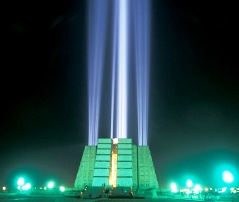
Under construction for some 40 years, and inaugurated in time for the 500th anniversary of Christopher Columbus’s initial landing in the New World (which was not on Hispaniola, but in the Bahamas), this monstrously spooky concrete monument, half a mile long and 688 feet tall, reputedly cost the impoverished nation some $70 million to build. The lighthouse contains what are purported to be the explorer’s bones.

Weird Wiring: When the lighthouse projects a cross-shaped beam into the night sky, it’s so bright that not only can it be seen in Puerto Rico, but it drains electrical power from surrounding neighborhoods. It’s not turned on very often.

Oriental Pearl TV Tower, Shanghai, China
iStock
Oriental Pearl TV Tower

Shanghai, China

Nothing else on earth quite looks like the Oriental Pearl. It was once the tallest structure on the Pudong side of Shanghai’s Huangpu River until it was overshadowed by the Shanghai World Financial Center in 2007. Designed by Jiang Huan Cheng of the Shanghai Modern Architectural Design Co. and completed in 1995, it stands 1,535 feet tall and is easily the world’s greatest assemblage of habitable disco balls (11!), housing several sightseeing observatories, a revolving restaurant, and a “space hotel.”

Tall Tale: Both Shanghai towers have recently been dwarfed by the 2,001-foot-tall Guangzhou TV and Sightseeing Tower.

Spittelau District Heating Plant, Vienna, Austria
imagebroker/Alamy
Spittelau District Heating Plant


Vienna, Austria

Highly eccentric painter and architect Friedensreich Hundertwasser, fond of bright colors, crooked lines, and overall visual cacophony, designed this garbage-burning heating plant on the Donau Canal to look like Vienna’s answer to the Magic Kingdom. With its crazy quilt façade, decorative columns topped with gold balls, and a pollution-scrubbing smokestack, it suggests a mirage rather than a working piece of urban infrastructure.

Odd Couple: There are two of these oddities. The Maishima Incineration Plant in Osaka, Japan, is an exact replica.

Elbe Philharmonic, Hamburg, Germany
Herzog & de Meuron
Elbe Philharmonic


Hamburg, Germany

What’s really freakish here is the contrast between the new building—a liquidy-looking glass thingamajig—and the old building it uses for its podium: a stolid, workaday 1960s waterfront warehouse. This odd couple, united by the Swiss architecture firm Herzog & de Meuron and scheduled for completion in 2012, will be a new cultural complex for Hamburg’s harbor, featuring a public plaza on the old warehouse roof, a hotel, some apartments, and a wildly biomorphic philharmonic hall.

Odd Trend: This new building atop old building thing is a bona fide trend. See: New York’s Hearst Tower by Foster + Partners.

The Atomium, Brussels, Belgium
nagelestock.com/Alamy
The Atomium

Brussels, Belgium


A 1958 World’s Fair leftover, the Atomium is far more eccentric than the 1964 Unisphere in New York or the 1962 Space Needle in Seattle. Conceived by an engineer, André Waterkeyn, it is a gigantic replica of an iron crystal molecule and was intended to symbolize “the peaceful use of atomic energy for scientific purposes.” Five of its nine spheres are accessible to visitors, as is its maze of interconnecting tubes.

Quirky Quote: According to the Atomium website: “The completely steel-clad Atomium is a kind of UFO in the cultural history of Humanity, a mirror turned simultaneously towards the past and the future, comparing our Utopias of yesterday with our dreams for tomorrow.”