Search This Blog

Showing posts with label Tourism. Show all posts

Monday, June 6, 2011

World's Best New Hotels 2011

From a hillside African lodge to a Brazilian eco-retreat, these are the year’s best new hotels.

By Travel+Leisure Staff


For our annual It List, a compendium of the world’s most noteworthy new hotels, Travel+Leisure editors and writers logged thousands of miles in search of the next best new hotels for you to lay your head.


Cosmopolitan

Las Vegas


Finally, a Vegas hotel for design geeks and food nerds. Guest rooms have Fornasetti wallpaper in the closets, furniture with solid modern lines, a generous soaking tub, C.O. Bigelow toiletries, art you will actually think about, and stacks of Phaidon books on the bedside. Venture into the David Rockwell–designed Chandelier bar and to restaurants by heavyweights including Scott Conant (Scarpetta), Bromberg Brothers (Blue Ribbon Sushi Bar & Grill), and José Andrés (Jaleo; China Poblano). Doubles from $195.


Olarro

Loita Hills, Kenya


With a silent partner like Paul Allen (yes, that Paul Allen) backing Olarro, it’s no wonder this hillside lodge overlooking the Masai Mara is becoming Kenya’s next high-profile hideaway. Designer Anthony Russell has worked his magic on the seven thatched cottages and a two-bedroom villa: the tiled floors resemble giraffe markings, and the billowing fabric ceilings give the feel of a tented camp (without the hassle of having to unzip your door). At this new conservancy the wildlife may not be as prolific as in other parts of Africa, but after-dark safaris with night-vision goggles, as well as a perfect perch to watch the annual wildebeest migration, more than compensate. Doubles from $1,370.


GoldenEye Hotel & Resort

Jamaica


This property on the northern coast of Jamaica has quite a pedigree: in the 1940’s, Ian Fleming built a villa on a hidden cove to write his James Bond novels and entertain visitors including Noël Coward and Errol Flynn. Now owner Chris Blackwell has transformed GoldenEye into a small but stylish resort. With only 11 cottages and six suites along a white-sand beach and secluded lagoon, the vibe is as exclusive as it was in Fleming’s day and the guest list just as impressive (was that Beyoncé and Jay-Z hanging out at the waterfront Bizot bar?). Doubles from $448.


Banyan Tree Al Wadi

Ras Al Khaimah, U.A.E.


Camel rides? Check. Sand dunes? Check. Private pools? Check. The new Banyan Tree Al Wadi—tucked into the desert and a 45-minute drive from Dubai—is a daydreamer’s oasis. Set on 250 acres, 150 of which are a nature preserve, 101 villas blend regional design elements (bedouin-style tented ceilings) with Far Eastern service touches (the spa specializes in Thai massages). We rose early for a tour of the honey-colored landscape and returned to dine at the resort’s Al Waha restaurant while spotting wild gazelles through the restaurant’s floor-to-ceiling windows. Doubles from $465.


Kenoa

Barra de São Miguel, Brazil


It was a risky proposition for engineer Pedro Marques to quit his career to open a 23-room eco-retreat on a sleepy beach along Brazil’s Alagoan coast, north of Bahia. But the gamble has paid off in spades. The hotel wows with eucalyptus columns and natural wood and brick interiors, all of which reinforce the indoor-outdoor aesthetic that sets the retreat apart. Environmental responsibility is emphasized: staffers are instructed in conservation techniques to avoid disturbing the nearby preserve. Doubles from $630.


Borgo Egnazia

Puglia, Italy


Though this blinding-white stone monolith looks as ancient as the fortified farmhouses that surround it, sprawling Borgo Egnazia is actually brand- new. Rooms are monochromatic, splicing luxe (limestone double sinks; wide shaded terraces) with unexpected design moments (single olive branches in lieu of flowers). Twin pools are lounge-worthy and huge; if only management would designate one of them exclusively for adults. Doubles from $455.


Taj Falaknuma Palace

Hyderabad, India


You’ll trade your car for a horse and carriage at the gate of the Taj Falaknuma Palace, which crowns a hill above the city, and be showered with rose petals when you ascend the marble steps. After a 10-year restoration, this former palace of the Nizam of Hyderabad (once the world’s richest man) is now a living museum, with 60 opulent guest rooms done up in ivories and golds. Wander the property if you like: nothing is off limits, including the library of rare books. Adding to the fairy-tale setting, at sunset you’ll hear the lilting strains of a flute in the courtyard. Doubles from $890.


Ritz-Carlton Shanghai

Pudong, Shanghai


It’s almost impossible to actually walk anywhere in the frenetic Pudong neighborhood, so lucky for you that Ritz-Carlton’s second Shanghai property offers plenty of reasons to stay put. Topping off Cesar Pelli’s 58-story IFC Shanghai building, the 285-room hotel places you in a cloud-level fantasy. Guest rooms, with their Art Deco touches, have skyline views from floor-to-ceiling windows, Frette linens, and freestanding bathtubs built for lounging. Doubles from $534.


W Retreat Koh Samui

Thailand


Bringing a long-lacking dose of mod design and youthful exuberance to this ever-popular Thai resort island, W Hotels’ first “Retreat” property in Southeast Asia hews to the brand’s urbane aesthetic. Fans of the cheeky W formula will find all the requisite diversions, such as morning Thai boxing. Seeking serenity? The resort occupies a coveted peninsula on Samui’s quiet northern coast. While the lure of the beach may be hard to resist, guest rooms offer plenty of watery temptations as well: all of the 75 glass-walled villas have private pools, and the best offer shimmering Gulf of Thailand views. Doubles from $712.


Matakauri Lodge

Queenstown, New Zealand


It’s no wonder hedge-funder turned hotelier Julian Robertson chose a secluded South Island spot for his family’s third hotel, Matakauri Lodge, the latest sibling to the Farm at Cape Kidnappers and the Lodge at Kauri Cliffs. The property is ideal for adventurers in search of a luxury lodge near Queenstown. The 11 large, timber suites, decorated in rust, orange, and cream by native design doyenne Virginia Fisher, feature walk-in closets, open fireplaces, and the requisite mountain vistas. Doubles from $460.

Monday, May 23, 2011

World's Best Ruins

By Christine Sarkis


Ruins reach across centuries to fire the imagination and fuel travel plans. The very best make you feel young, small, and utterly amazed by the architectural chops of the ancients. Among the many amazing ruins that still exist today, a few stand out as the trip of a lifetime.

No matter which ruins you visit, a few rules hold true: Time your trip for the less crowded times of day, often early or late. Give yourself plenty of time, as some ruins require days of exploration. Hire a knowledgeable guide, since the history is rich but the signage is often cursory. And get beyond the most popular parts of the ruin; you'll need a bit of quiet space to appreciate this kind of ancient majesty.


Machu Picchu, Peru


The journey to Machu Picchu is epic even with relatively newfangled transportation like trains. But each year, about 25,000 people forgo the more direct routes and walk for days along the 27-mile Inca Trail to reach the ruin. Since its rediscovery a century ago, this treasure of the Inca set high in a cloud forest of the Peruvian Andes has captured imaginations worldwide. The massive stone blocks tell the story of both a sprawling agricultural zone with terracing and ancient food storehouses and an urban zone replete with temples, squares, tombs, and living quarters. If you're considering a trek to Machu Picchu, plan ahead: You can only make the hike with a licensed company, and spots book up quickly, especially in high season.


Acropolis, Greece


Waiting for the traffic to speed past at a crowded intersection in Athens, you're likely to forget that history keeps constant watch over the city. Glance up, however, and you'll catch the view Athenians and visitors alike have been admiring for the last 2,500 years. Time has battered the once-pristine temples and gates that crown the hill of the Acropolis, leaving stone ruins that retain a familiar splendor even after thousands of years of wear and destruction. The elegant proportions of the fifth-century B.C. Parthenon and the Temple of Athena Nike—both dedicated to the city's patron deity—are a reminder of how much we still rely on ancient Greece for our concepts of beauty.


Mesa Verde, United States


Great ruins aren't always an ocean away: Some of the best preserved Native American cliff dwellings in North America reside in Mesa Verde National Park in Colorado. Home to the Ancestral Puebloans—whose descendants became 20 different Southwestern tribes, including the Hopi and Zuni—Mesa Verde traces 700 years of history across 4,000 archeological sites. Visit mesa-top pueblos and the dwellings built beneath massive overhanging cliffs. Ascend steep trails and ladders, or crawl through tunnels to explore ancient architecture such as the 150-room Cliff Palace or the hard-to-reach Balcony House. The park's hours vary by season, and not all sites are open year-round.


Angkor, Cambodia


War or natural disaster might have weakened the Khmer Empire's ancient capital, but ultimately, it was the jungle that conquered this ninth- to fifteenth-century urban center. Today, the densely forested 150-square-mile Angkor Archaeological Park protects part of a vast cluster of ancient capitals, many of which remain buried. The park's most famous temple, Angkor Wat, is the world's largest religious building. But the park's dozens of other ruins, including Bayon temple with its wall of 11,000 carved figures, offer quieter glimpses into the art and architecture of this culturally rich 600-year period.


Great Pyramids And Memphis, Egypt


Political unrest or no, a roundup of the world's best ruins can't exclude Egypt. The last existing ancient wonder of the world, the Great Pyramid of Giza stands as a lone window into the far past. With more than 4,000 years to ponder the question, experts still can't agree on how the builders placed more than 2 million stone blocks so perfectly. The rest of the Giza Necropolis holds more wonders: two more Great Pyramids, built during 80 years by 20,000 to 30,000 workers, plus the Great Sphinx, cemeteries, and the ruins of a village. The pyramids are part of a larger UNESCO World Heritage site that includes Memphis, the capital of the Old Kingdom of Egypt. A trip can even include some up-close-and-personal time: Visitors can explore the interiors of some of the pyramids. And the recent drop in tourism offers intrepid travelers the rare chance to experience the pyramids without the usual crowds.


Tikal, Guatemala


Stay overnight in the national park for the ultimate experience at Tikal, an ancient Maya city in northern Guatemala that was home to 90,000 people before being abandoned in the tenth century. Early the next morning, before the park opens to the general public, join a small group making the trek through a jungle awash in the pre-dawn symphony of birds and insects. Climb to the top of Temple IV, the Temple of the Two-Headed Serpent, to witness a sunrise that reveals ancient temples and pyramids rising from the verdant forest blanket. You've still got hours to explore this vast complex of pyramids, temples, and plazas before the big crowds roll in. Along the way, catch glimpses of brown coatis, toucans, howler monkeys, and some of the hundreds of other species to call Tikal home.


Petra, Jordan


Hailed as a "rose-red city half as old as time" in a 19th-century poem, the ancient city of Petra was half built and half carved into red sandstone cliffs. Nabataean Arabs established the city in the sixth century B.C., and for hundreds of years it thrived as a trade center for frankincense, myrrh, and spices. Now, as then, enter the ruins of the city through a narrow, half-mile-long gorge squeezed between cliffs nearly 300 feet high. Inside, explore architecturally elaborate tombs and temples, sacrificial altars, and even a Roman-style amphitheater. Most people explore on foot, but visitors can also ride camels and donkeys. The sun lights up the red cliffs of Petra most dramatically in mid-morning and late afternoon, so be sure to time your visit accordingly.


Colosseum, Italy


Digitally reimagined in Hollywood blockbusters such as Gladiator, the camera really shaves millennia off Rome's Colosseum. But the 2,000-year-old ruins are so evocative up close that special effects seem superfluous. With a bloody history of fights to the death between gladiators, slaves, prisoners, and wild animals, the Colosseum held 50,000 spectators or more in its heyday. Later, Romans used the abandoned arena as a quarry: Stones from the Colosseum are part of the cathedrals of St. Peter and St. John Lateran. Last summer, entirely new sections of the ruin—including the basement— were opened for tours.


Great Wall Of China, China


Like a dragon, the Great Wall of China slithers its way across the landscape for about 4,500 miles, and, like a dragon, the wall protects something treasured. Constructed to shelter China's people and culture from the outside world, the "Long Wall of 10 Thousand Li" was built during 2,000 years by many imperial dynasties. While some parts of the wall are in ruins or have disappeared entirely, other sections have been restored or preserved. The most popular section today is the Badaling Great Wall, close to Beijing. Slightly farther from the capital city and offering a more rugged (and less crowded) experience is the Great Wall at Mutianyu. In Qinhuangdao City, the Laolongtou Great Wall actually stretches into the sea, and is said to resemble a dragon drinking water.


Palmyra, Syria


Twice a day, at sunrise and sunset, the Bride of the Desert blushes, even 18 centuries after her birth. Palmyra, also known as Tadmor, is in the desert northeast of Damascus, Syria, and was once a wealthy caravan oasis along the Silk Road, linking Persia, India, and China with the Roman Empire. At a crossroads of cultures, the ruins of grand colonnaded streets, temples, funerary towers, and aqueducts demonstrate a mingling of influences that made this an awfully cosmopolitan place for the second century. Palmyra was also home to the warrior queen and conqueror Zenobia, and tour guides tell exciting tales that give this seemingly isolated place a starring role in world history.

Tuesday, May 17, 2011

End of an era as Vegas casino closes

End of an era as Vegas casino closes
AFP/Getty Images/File – A general view of the porte cochere at the Sahara Hotel & Casino in Las Vegas, Nevada, on May 11.

LAS VEGAS, Nevada (AFP) – Las Vegas marks the end of an era this week as one of the US gambling mecca's last original "Rat Pack" casino-hotels, the Sahara, finally closes its doors.

Opened in 1952, the Sahara hosted everyone from Elvis Presley and Jerry Lewis to Frank Sinatra and the Beatles in the 1950s and 60s, and their photos still decorate the walls above the reception.

But in recent decades Vegas saw an explosion of mega-sized casino resorts which left the "small" Sahara struggling to fill its 1,700 rooms at the end of the famous Strip.

The death knell was sounded in March, when its owners since 2007, SBE Entertainment, announced that the casino-hotel complex with its more than 1,050 staff was no longer a viable business.

"In a way it was a surprise, but in a way it wasn't," Michael McLendon, a supervisor in the casino's poker room -- already deserted ahead of Monday's final day -- told AFP.

"The way things were going, with the economy and all, we felt something was happening. We just didn't know what it was," he said. "I'm retiring. I'm done. There are not too many people out there looking for a 66 year-old anyway."

And with hard times hitting Vegas even harder than most US cities, the prospect of finding other jobs is not good.

"Some dealers here, just like porters, bartenders, cocktail waitresses, they found other jobs. But the majority didn't, because it's not a good time, now in Las Vegas, because of the economy," said McLendon.

Sheryl Reed, a waitress in the Nascar Cafe for 11 years, hasn't found anything. "It sucks ..You have to be in your 20s to work in Vegas, now. I left applications, they say they'll call you, but they never call," she said.

Dennis Carade, a front desk clerk for 39 years, has also chosen to retire. "I was offered a job in the Aria because a friend of mine works there," he said, referring to another Vegas casino.

"But you know, I've been in this business for 50 years, time's up," he said, recounting anecdotes about Elvis and Clint Eastwood -- who made "The Gauntlet" here in 1977.

He also doesn't mince his words about the Sahara's latest owners.

"These are the worst we've ever had. They came in here from California and they are very arrogant. It took them about three and half years to take this hotel right down to the ground," he said.

"These people should be ashamed to themselves," he added.

The management of SBE Entertainment declined to make any comment.

Far from its "Rat Pack" glory days, the Sahara has been known in recent years for its dollar-a-go games and the 6-pound, 2 foot (2.7 kilo, 60 cm) burrito available in the Nascar Cafe, dubbed "The Bomb."

But the hotel, with its Moroccan-style decor, its large Hollywood-style swimming pool and its ghosts -- Sol Arenas, a cleaner for 20 years, says she saw a "frightening and diabolical presence" in the Tangiers tower -- retained an outmoded charm which many will miss.

In the 1950s the "Rat Pack," a group of actors led by Sinatra but also including Dean Martin and Sammy Davis Jr., appeared in numerous Vegas shows and several films, including the original "Ocean's Eleven."

For French retirees and Strip habitues Brigitte and Daniel Quentin, who have already seen the demise of the Dunes, Stardust, New Frontier and Sands, the end of the Sahara is another body blow.

"We've stayed here several times and it is distressing," said Brigitte. "We knew our machines and the staff. It was a hotel with a human dimension, it had warmth."

It is a view shared by Tracy Reed, a Californian who has visited the Sahara four or five times a year for 15 years.

"It was like home. The other hotels are way too big. There's no contact, you can't meet people, get to know them. And here you got to know the employees, they got to know you by name, it's just very homey," she said.

In his little tattoo parlour, opposite the reception, Eric Ayala also voiced the hotel staff's emotional attachment to the hotel.

"This morning, we just got an employee who wanted a tattoo of the coin of the casino on his arm. He was sad, you know, he's been working here all his life".

Friday, July 30, 2010

The World's Largest Tent, Khan Shatyr, Debuts In Astana, Kazakhstan

The world's largest tent Khan Shatyr has debuted in Kazakhstan's capital city, Astana.

The nearly 500-foot tall structure is host to a variety of exciting green features, designed by Foster And Partners, who are known for implementing inspiring sustainable techniques in their other creations, like the Virgin Galactic Spaceport and the Queen Alia Airport.

Inhabitat reports that the arid region of Astana is subject to drastic shifts in temperature, so the Khan Shatyr is designed to remain between 60 to 85 degrees Fahrenheit, even when the outside atmosphere can vary from -30 to 95 degrees Fahrenheit.

The tent accomplishes this climate control in an efficient way by utilizing three translucent layers of ethylene tetrafluoroethylene (ETFE) fabric. Take a look at lush greenery inside of Khan Shatyr basking in the sunlight brought in from the illuminating material in this photo.

In the winter, this exterior channels light and warm air to prevent condensation. In the summer, the cool air displaces the hot air which is vented through the top.

A 492-foot tripod column runs up the center of the tent, supporting a web of cables attached to the EFTE skin, stretching out to a radius of over 650 feet. Take a look at this incredible photo that shows the central tripod stretching from the uppermost peak down to the bustling visitors below.


With over one million square feet of space provided inside for the people of Kazakhstan to enjoy, the Khan Shatyr contains everything from a water park and garden to a shopping mall and movie complex. And of course, there are plenty of restaurants!


See more stunning photos of the Khan Shatyr, the world's largest tent.

Read More: Astana, Biggest Tent, Biggest Tent Ever, Biggest Tent In World, Green Living, Kazakhstan, Khan Shatyr, Largest Tent, Largest Tent Ever, Largest Tent In World, Worlds Biggest Tent, Worlds Largest Tent

Thursday, May 13, 2010

World's Most Weird Structures

These odd, eye-popping structures — in England, China, and elsewhere — are worth a detour.

Between all the bubbly novelties that went up in pre-Olympics Beijing, and Dubai’s feverish invention over the past decade, nothing should surprise us. Except that some buildings still do. And these eccentric edifices, breathtaking in their strangeness, are worth a detour—if only to ginger up your worldview a bit.


Selfridges Department Store

Birmingham, England

The Birmingham branch of Selfridges is a billowy mattress of a building, clad in 15,000 shimmery aluminum discs like that famous Paco Rabanne dress. It was designed by Future Systems—the name tells you pretty much everything you need to know about the firm—to be a landmark and a catalyst for the revitalization of a largely moribund city center. “An ersatz urban cliff, a giant sea anemone, a friendly, blob-like alien, the mother of all magic mushrooms,” wrote Guardian architecture critic Jonathan Glancey. “This is the department store as unalloyed architectural entertainment.”

Step Inside: The interior, with floaty white escalators crisscrossing in an open atrium, looks like a scene from Fritz Lang’s Metropolis.

The Bar Code Building, St. Petersburg, Russia
Anton Chmelev
The Bar Code Building

St. Petersburg, Russia


Near the banks of the Neva River, this trade complex by Vitruvius & Sons transforms the world’s most ubiquitous symbol of commerce—the bar code—into a powerful architectural motif. It can be read as an update of American-style roadside classics like the giant Dixie Cup water tower of Lexington, KY, or Detroit’s giant Uniroyal Tire. The rust-red steel building brightens an otherwise bleak urban setting.

Strange Trend: There’s also a Barcode House by the Dutch architecture firm MVRDV on the outskirts of Munich, but it’s much more subtle.

Bioscleave House,East Hampton, N.Y.
Eric Striffler/The New York Times/Redux
Bioscleave House

East Hampton, N.Y.

Husband and wife artists Arakawa and Madeline Gins designed this intentionally unsettling house in 2008. With its bumpy, hilly floors and a wildly asymmetrical plan—even the electrical outlets are at weird angles—it’s supposed to stimulate the immune systems of its occupants by keeping them from ever becoming comfortable. This relentless “tentativeness,” the artists believe, is the key to immortality.

Embrace the Strange: This house can be yours. It’s currently offered by Sotheby’s Realty for $4 million.

Ontario College of Art and Design, Toronto
Richard Johnson
Ontario College of Art and Design

Toronto

This crossword puzzle checked box appears, at a distance, to be hovering Close Encounters–style above an otherwise mundane Toronto neighborhood. As you approach, its improbability only increases. British architect Will Alsop planted this collection of galleries and studio spaces on brightly colored columns so insouciantly angled and skinny that they barely look like they can support themselves.

Nearby Oddity: There goes the neighborhood: Daniel Libeskind’s bizarre 2007 crystalline addition to Toronto’s Royal Ontario Museum is just a mile away.

Ramot Polin Apartments, Jerusalem, Israel
Israel images/Alamy
Ramot Polin Apartments

Jerusalem, Israel

Polish-born architect Zvi Hecker’s experiment in multi-unit residential construction is not as well known as the Habitat housing Moshe Safdie designed for Expo 67 in Montreal, but at 720 units is much larger. It was also an exercise in using prefabricated components, at least in the first two of its five phases. With its crazy pentagonal design, the Ramot Polin Apartments resemble a housing project for honeybees.

Behind the Scenes: This highly unorthodox complex was commissioned by the Israeli ministry of housing specifically for highly orthodox Jewish families.

Columbus Lighthouse, Santo Domingo, Dominican Republic
M. Timothy O'Keefe/Alamy
Columbus Lighthouse

Santo Domingo, Dominican Republic

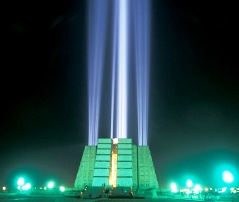
Under construction for some 40 years, and inaugurated in time for the 500th anniversary of Christopher Columbus’s initial landing in the New World (which was not on Hispaniola, but in the Bahamas), this monstrously spooky concrete monument, half a mile long and 688 feet tall, reputedly cost the impoverished nation some $70 million to build. The lighthouse contains what are purported to be the explorer’s bones.

Weird Wiring: When the lighthouse projects a cross-shaped beam into the night sky, it’s so bright that not only can it be seen in Puerto Rico, but it drains electrical power from surrounding neighborhoods. It’s not turned on very often.

Oriental Pearl TV Tower, Shanghai, China
iStock
Oriental Pearl TV Tower

Shanghai, China

Nothing else on earth quite looks like the Oriental Pearl. It was once the tallest structure on the Pudong side of Shanghai’s Huangpu River until it was overshadowed by the Shanghai World Financial Center in 2007. Designed by Jiang Huan Cheng of the Shanghai Modern Architectural Design Co. and completed in 1995, it stands 1,535 feet tall and is easily the world’s greatest assemblage of habitable disco balls (11!), housing several sightseeing observatories, a revolving restaurant, and a “space hotel.”

Tall Tale: Both Shanghai towers have recently been dwarfed by the 2,001-foot-tall Guangzhou TV and Sightseeing Tower.

Spittelau District Heating Plant, Vienna, Austria
imagebroker/Alamy
Spittelau District Heating Plant


Vienna, Austria

Highly eccentric painter and architect Friedensreich Hundertwasser, fond of bright colors, crooked lines, and overall visual cacophony, designed this garbage-burning heating plant on the Donau Canal to look like Vienna’s answer to the Magic Kingdom. With its crazy quilt façade, decorative columns topped with gold balls, and a pollution-scrubbing smokestack, it suggests a mirage rather than a working piece of urban infrastructure.

Odd Couple: There are two of these oddities. The Maishima Incineration Plant in Osaka, Japan, is an exact replica.

Elbe Philharmonic, Hamburg, Germany
Herzog & de Meuron
Elbe Philharmonic


Hamburg, Germany

What’s really freakish here is the contrast between the new building—a liquidy-looking glass thingamajig—and the old building it uses for its podium: a stolid, workaday 1960s waterfront warehouse. This odd couple, united by the Swiss architecture firm Herzog & de Meuron and scheduled for completion in 2012, will be a new cultural complex for Hamburg’s harbor, featuring a public plaza on the old warehouse roof, a hotel, some apartments, and a wildly biomorphic philharmonic hall.

Odd Trend: This new building atop old building thing is a bona fide trend. See: New York’s Hearst Tower by Foster + Partners.

The Atomium, Brussels, Belgium
nagelestock.com/Alamy
The Atomium

Brussels, Belgium


A 1958 World’s Fair leftover, the Atomium is far more eccentric than the 1964 Unisphere in New York or the 1962 Space Needle in Seattle. Conceived by an engineer, André Waterkeyn, it is a gigantic replica of an iron crystal molecule and was intended to symbolize “the peaceful use of atomic energy for scientific purposes.” Five of its nine spheres are accessible to visitors, as is its maze of interconnecting tubes.

Quirky Quote: According to the Atomium website: “The completely steel-clad Atomium is a kind of UFO in the cultural history of Humanity, a mirror turned simultaneously towards the past and the future, comparing our Utopias of yesterday with our dreams for tomorrow.”