Between all the bubbly novelties that went up in pre-Olympics Beijing, and Dubai’s feverish invention over the past decade, nothing should surprise us. Except that some buildings still do. And these eccentric edifices, breathtaking in their strangeness, are worth a detour—if only to ginger up your worldview a bit.
Selfridges Department Store
Birmingham, England

The Birmingham branch of Selfridges is a billowy mattress of a building, clad in 15,000 shimmery aluminum discs like that famous Paco Rabanne dress. It was designed by Future Systems—the name tells you pretty much everything you need to know about the firm—to be a landmark and a catalyst for the revitalization of a largely moribund city center. “An ersatz urban cliff, a giant sea anemone, a friendly, blob-like alien, the mother of all magic mushrooms,” wrote Guardian architecture critic Jonathan Glancey. “This is the department store as unalloyed architectural entertainment.”
Step Inside: The interior, with floaty white escalators crisscrossing in an open atrium, looks like a scene from Fritz Lang’s Metropolis.
The Bar Code Building, St. Petersburg, Russia
Anton Chmelev
The Bar Code Building
St. Petersburg, Russia

Near the banks of the Neva River, this trade complex by Vitruvius & Sons transforms the world’s most ubiquitous symbol of commerce—the bar code—into a powerful architectural motif. It can be read as an update of American-style roadside classics like the giant Dixie Cup water tower of Lexington, KY, or Detroit’s giant Uniroyal Tire. The rust-red steel building brightens an otherwise bleak urban setting.
Strange Trend: There’s also a Barcode House by the Dutch architecture firm MVRDV on the outskirts of Munich, but it’s much more subtle.
Bioscleave House,East Hampton, N.Y.
Eric Striffler/The New York Times/Redux
Bioscleave House
East Hampton, N.Y.

Husband and wife artists Arakawa and Madeline Gins designed this intentionally unsettling house in 2008. With its bumpy, hilly floors and a wildly asymmetrical plan—even the electrical outlets are at weird angles—it’s supposed to stimulate the immune systems of its occupants by keeping them from ever becoming comfortable. This relentless “tentativeness,” the artists believe, is the key to immortality.
Embrace the Strange: This house can be yours. It’s currently offered by Sotheby’s Realty for $4 million.
Ontario College of Art and Design, Toronto
Richard Johnson
Ontario College of Art and Design
Toronto

This crossword puzzle checked box appears, at a distance, to be hovering Close Encounters–style above an otherwise mundane Toronto neighborhood. As you approach, its improbability only increases. British architect Will Alsop planted this collection of galleries and studio spaces on brightly colored columns so insouciantly angled and skinny that they barely look like they can support themselves.
Nearby Oddity: There goes the neighborhood: Daniel Libeskind’s bizarre 2007 crystalline addition to Toronto’s Royal Ontario Museum is just a mile away.
Ramot Polin Apartments, Jerusalem, Israel
Israel images/Alamy
Ramot Polin Apartments
Jerusalem, Israel

Polish-born architect Zvi Hecker’s experiment in multi-unit residential construction is not as well known as the Habitat housing Moshe Safdie designed for Expo 67 in Montreal, but at 720 units is much larger. It was also an exercise in using prefabricated components, at least in the first two of its five phases. With its crazy pentagonal design, the Ramot Polin Apartments resemble a housing project for honeybees.
Behind the Scenes: This highly unorthodox complex was commissioned by the Israeli ministry of housing specifically for highly orthodox Jewish families.
Columbus Lighthouse, Santo Domingo, Dominican Republic
M. Timothy O'Keefe/Alamy
Columbus Lighthouse
Santo Domingo, Dominican Republic
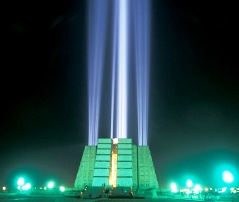
Under construction for some 40 years, and inaugurated in time for the 500th anniversary of Christopher Columbus’s initial landing in the New World (which was not on Hispaniola, but in the Bahamas), this monstrously spooky concrete monument, half a mile long and 688 feet tall, reputedly cost the impoverished nation some $70 million to build. The lighthouse contains what are purported to be the explorer’s bones.
Weird Wiring: When the lighthouse projects a cross-shaped beam into the night sky, it’s so bright that not only can it be seen in Puerto Rico, but it drains electrical power from surrounding neighborhoods. It’s not turned on very often.
Oriental Pearl TV Tower, Shanghai, China
iStock
Oriental Pearl TV Tower
Shanghai, China

Nothing else on earth quite looks like the Oriental Pearl. It was once the tallest structure on the Pudong side of Shanghai’s Huangpu River until it was overshadowed by the Shanghai World Financial Center in 2007. Designed by Jiang Huan Cheng of the Shanghai Modern Architectural Design Co. and completed in 1995, it stands 1,535 feet tall and is easily the world’s greatest assemblage of habitable disco balls (11!), housing several sightseeing observatories, a revolving restaurant, and a “space hotel.”
Tall Tale: Both Shanghai towers have recently been dwarfed by the 2,001-foot-tall Guangzhou TV and Sightseeing Tower.
Spittelau District Heating Plant, Vienna, Austria
imagebroker/Alamy
Spittelau District Heating Plant
Vienna, Austria

Highly eccentric painter and architect Friedensreich Hundertwasser, fond of bright colors, crooked lines, and overall visual cacophony, designed this garbage-burning heating plant on the Donau Canal to look like Vienna’s answer to the Magic Kingdom. With its crazy quilt façade, decorative columns topped with gold balls, and a pollution-scrubbing smokestack, it suggests a mirage rather than a working piece of urban infrastructure.
Odd Couple: There are two of these oddities. The Maishima Incineration Plant in Osaka, Japan, is an exact replica.
Elbe Philharmonic, Hamburg, Germany
Herzog & de Meuron
Elbe Philharmonic
Hamburg, Germany

What’s really freakish here is the contrast between the new building—a liquidy-looking glass thingamajig—and the old building it uses for its podium: a stolid, workaday 1960s waterfront warehouse. This odd couple, united by the Swiss architecture firm Herzog & de Meuron and scheduled for completion in 2012, will be a new cultural complex for Hamburg’s harbor, featuring a public plaza on the old warehouse roof, a hotel, some apartments, and a wildly biomorphic philharmonic hall.
Odd Trend: This new building atop old building thing is a bona fide trend. See: New York’s Hearst Tower by Foster + Partners.
The Atomium, Brussels, Belgium
nagelestock.com/Alamy
The Atomium
Brussels, Belgium

A 1958 World’s Fair leftover, the Atomium is far more eccentric than the 1964 Unisphere in New York or the 1962 Space Needle in Seattle. Conceived by an engineer, André Waterkeyn, it is a gigantic replica of an iron crystal molecule and was intended to symbolize “the peaceful use of atomic energy for scientific purposes.” Five of its nine spheres are accessible to visitors, as is its maze of interconnecting tubes.
Quirky Quote: According to the Atomium website: “The completely steel-clad Atomium is a kind of UFO in the cultural history of Humanity, a mirror turned simultaneously towards the past and the future, comparing our Utopias of yesterday with our dreams for tomorrow.”

