Search This Blog

Saturday, July 16, 2011

Wreck of Canadian schooner found in Lake Ontario

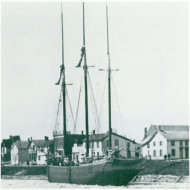
ROCHESTER, N.Y. (AP) — After 105 years, the three masts of the Queen of the Lakes still stand erect — all the more remarkable because the 19th-century Canadian schooner has sat in the dark depths of Lake Ontario since it wrecked in 1906.

"We think it hit bow first because the bowsprit is broken off, but the rest of the ship looks pretty nice," undersea explorer Jim Kennard said Friday.

Kennard and fellow shipwreck enthusiasts Dan Scoville and Roland Stevens located the 129-foot-long vessel using side-scan sonar in 2009. They confirmed the find and captured images of it in early July using a remotely operated submersible.

Loaded with 480 tons of coal, the 53-year-old ship ran into a stiff gale in November 1906, sprung a leak and sank rapidly some 10 miles off Sodus Bay on the lake's southern shore. The crew of six clambered aboard a yawl and rowed to safety.

The ship sits on the lake bed at a depth of 200 to 300 feet. Its masts extend as much as 100 feet upward in calm, frigid waters deprived of oxygen, conditions that account for how well it's preserved.

"When you have a temperature of, like, 39 degrees and you're at a depth where there's no wave action or current, the only thing that can damage the wood would be zebra or quagga mussels as they collect and grow in big clumps and fall off," Kennard said.

The invasive mussels were not introduced to the lake system until the past 15 years or so, he said. "Years ago, all you would see on the ship was just a dusting of silt," he added.

Its rigging and sails have long since disintegrated and the large, tapered spar extending forward from the bow is gone.

But both anchors and the mussel-coated wheel are firmly in place. Cables that held the masts in place lie in coils on the deck and a steam-powered winch that might have been added in the early 1900s is visible in the bow section.

The ship was sailing from Rochester to Kingston, Canada, when it began taking on water.

"I've read the most important item on such ships was the bilge pump," Kennard said. "A vessel that old was pushing its limits. In a Northeast storm, things are really getting jostled around and, all of a sudden, the bottom fell out. The crewmen were only within 50 feet of the boat when it sank. It went down really quickly."

In 2008 in Lake Ontario, Kennard's team located the wreck of the HMS Ontario, the oldest shipwreck ever found in the Great Lakes. During the American Revolution in 1780, the 22-gun British warship was lost in a gale with barely a trace and as many as 130 people aboard.

Since 1970, Kennard has helped find more than 20 wrecks in the Great Lakes and about 180 others in Lake Champlain, New York's Finger Lakes and the Mississippi and Ohio rivers.

Friday, July 15, 2011

Jennifer Lopez And Marc Anthony Split

Jenny's back on the singles block.


After seven years of marriage, Jennifer Lopez and Marc Anthony have separated, their rep tells Us Weekly exclusively.


"We have decided to end our marriage. This was a very difficult decision. We have come to amicable conclusion on all matters," they said in a statement. "It is a painful time for all involved, and we appreciate the respect of our privacy at this time."

The couple are parents to three-year-old twins Max and Emme.

Crooner Anthony, 42, was conspicuously absent at Saturday's star-packed BAFTA Brits to Watch bash in L.A., where wife Lopez, 40, met Prince William and Duchess Kate with mom Guadalupe as her date.

Friends for years, Lopez and Anthony dated briefly in the 1990s. They stepped out again as a couple in early 2004, shortly after Lopez's broken engagement from Ben Affleck, and in the midst of Anthony's divorce from first wife, former Miss Universe Dayanara Torres. They wed at a quiet home wedding in June 2004.

Just last year, they renewed their wedding vows for their sixth anniversary at their Hidden Hills, Calif. estate June 5. "We realized the bets in Vegas [on whether we'd make it] stopped at five years," Anthony joked to Us at the time. (The duo also renewed their vows in 2008, and playfully dirty-danced together at Us Weekly's Hot Hollywood bash in April 2010.)

And as recently as January, singer, actress and American Idol judge Lopez gushed on the Ellen DeGeneres Show about being a parent with Anthony. "As soon as I had the babies, I thought to myself, 'I want to do this a thousand more times...I love this. This is life."

Anthony and first wife Torres share sons Cristin, 10, and Ryan, 7. Lopez (who famously dated Sean Combs in addition to Affleck), had been married twice before: to restauranteur Ojani Noa (they split in 1998) and former backup dancer Cris Judd, to whom she was married from 2001 to 2003.

Monday, July 11, 2011

10 Advantages of Cash (Say No to ATM and Credit Cards)

The Treasury may be printing fewer dollars, but I'm going all cash.

The dollar bill needs you.

A growing number of merchants won't accept cash anymore. That includes a lot of airlines, which insist you pay by credit card if you want to buy a drink or a sandwich on board. And now comes news that the U.S. Treasury is printing fewer dollars, as we move towards an all-plastic economy.


Great news for the banks. Great news for the card companies. Great news for the marketing establishment, which can now pore through our transactions and our personal lives in greater and greater detail.

Me? Call me a contrarian, or just call me ornery, but I view this with gloom. This not a step forward. It's a step backwards. Personally, I've been moving the other way. I've cut down on my use of credit cards and debit cards. The latest news is the final push I needed to get them out of my life completely. I'm going all cash

Here are 10 reasons why:

1. I'll spend less. A variety of scientific studies, such as this one at the Massachusetts Institute of Technology, have found that people are simply willing to spend more when they use credit cards than they do when they use cash. It's common sense. No wonder our national obsession with shopping really took off when credit cards came on the scene. And I've found it personally. Last fall and winter, when I went for an extended period without carrying any plastic at all, my day-to-day spending rate absolutely collapsed.

2. The card bonuses aren't worth it. A lot of people use their credit cards for the frequent flyer miles or other bonuses. But many of these deals are getting less valuable. Airlines are cutting back on flyer programs. And how good were these programs anyway? Schwark Satyavolu, co-founder of BillShrink, says that if you are really smart, dedicated and targeted about getting and using your bonuses, you can sometimes get very good deals. But overall, he says, deals are getting less valuable, and are increasingly focused on cards with annual fees. Most of us are doing very well if we manage to get back 2% on our cards. Compared to the extra amount you spend, that's chicken feed.

3. Cash makes budgeting easy. Personal financial planners encourage clients to draw up budgets. It's great advice, in theory anyway. But I have a confession: I'm just not that organized. Nor, I suspect, are lots of people. But if I go to the bank once a week and draw out a certain amount of cash, it makes the budgeting automatic. Easy.

4. Less worry about identity theft. Do you worry about handing out your card or details every time you make a purchase? I do. The banks and online merchants work hard to maintain security, but the crooks are just as inventive. And there are plenty of them. People suffer identity theft all the time. Using cash cuts down on the risk.

5. Fewer impulse purchases. One way credit cards let us spend more is that they make it easier to buy things that we don't need, and may not even want, on the spur of the moment. And the stores are set up to encourage it they rely on sophisticated marketing science to manipulate you into reaching into your wallet. If you don't have the money on you, you can't splurge. If you really want the item in question, you can come back and buy it tomorrow. Chances are you won't.

6. I can still shop online. Just because I'm using cash doesn't bar me completely from getting online deals. Yes, I'll have to bend a principle, but I won't have to break it: I can buy a prepaid card in a store and charge it up with cash. Okay, so it's plastic, but I have to pay for it in advance, with cash, and it will have a limit. (On the same principle, I can also use a prepaid card as an emergency backup if I travel).

7. Say goodbye to debt. I pay my cards off in full every month, but a lot of people don't. They use their cards to borrow, and it's a financial disaster. We've seen what the overuse of debt has done to our economy. According to Bankrate.com, the average card charges you 14% interest. Many charge a lot more. And you're paying with after-tax dollars. As an illustration, you'd have to earn at least 16.5% on the stock market (before long-term capital gains tax of 15%) just to keep up. Good luck with that. Says New York University's Stern School of Business, since 1928, U.S. stocks have produced an average compound return of just 9.7%. And Bankrate calculates that someone who buys a $1,000 item on a credit card charging 14% interest, and merely pays 2% of the balance each month, will end up paying $1,750 for that item. It will take 110 months to pay off the bill.

8. Privacy. Credit cards are great for tracking people. They tell you exactly what you bought, where and when. (Throw in all the data tracked by your smartphone, your iPad and so on, and we're basically rats scurrying around in a Perspex cage while marketing strategists study our every move). I have to confess I hate it. And I love the privacy and anonymity of cash. Last week I meet my wife for lunch. But I stopped by my bank first to take out cash. It's none of American Express' business.

9. Cash rebuilds the link between what I earn and what I spend. I remember back when I got my first job: I started calculating how much everything I spent cost in terms of hours worked. That new CD cost two hours of my time, and so on. It was a good discipline. Credit cards weaken the link. It's no wonder that the rise in plastic has resulted in an explosion in the numbers living beyond their means. (Is it also a coincidence that the rise of the credit card has also coincided with the collapse in unions? Before VISA, if you wanted a fancier car or vacation next year, you needed a pay raise).

10. Cash helps people I want to help. The money goes to the merchant and his suppliers. When I go into my local credit union to cash a check, I'm keeping a couple of local tellers in work. Credit cards? I'm helping finance bank executives, marketing teams and call centers in India. I am sure they are all fine people, and I wish them well. But if I had to choose, and I do, I would rather help my local merchants and credit union staff.

Tug-of-war over Iraqi Jewish trove in US hands


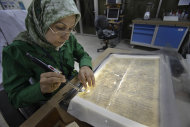
LAGOS, NIGERIA (Aladdin Sodiq Blog) — A trove of Jewish books and other materials, rescued from a sewage-filled Baghdad basement during the 2003 invasion, is now caught up in a tug-of-war between the U.S. and Iraq.

Ranging from a medieval religious book to children's Hebrew primers, from photos to Torah cases, the collection is testimony to a once vibrant Jewish community in Baghdad. Their present-day context is the relationship, fraught with distrust, between postwar Iraq and its Jewish diaspora.

Discovered in a basement used by Saddam Hussein's secret police, the collection was sent to the U.S. for safekeeping and restoration, and sat at the National Archives and Records Administration (NARA) in Maryland until last year, when Iraqi officials started a campaign to get it back.

Initially contacts went well, but now the deputy culture minister, Taher Naser al-Hmood, says "The Americans are not serious" about setting a deadline for getting back the archive.

U.S. officials deny that they are delaying its return. They say they only recently got the roughly $3 million needed to clean up the materials — the whole point of bringing them to the U.S. — and they question the rush to return the collection now, when the goal is so close.

"It is not U.S. government material, and we have every intention of returning it," said Phil Frayne, a spokesman for the State Department's Bureau of Near Eastern Affairs.

"We understand the frustration over the delay but we're happy that this is going to finally move forward," he said.

But al-Hmood was skeptical, saying he had not been told about the money. "Let the American side prove its goodwill," he said. "We cannot trust the Americans. They have not fulfilled their previous promises."

The case is complicated by the knee-jerk suspicions that cloud everything related to Jewish history in the Arab world, Iraq's attempts to assert its sovereignty after years of U.S. domination, and a diaspora trying to recover its history.

There are claims of Jewish pressure to prevent the return of the collection, and questions about why the U.S. didn't prevent the looting of Arab and Islamic treasures during the invasion but was able to bring the Jewish collection to safety in America. Among those voicing indignation about the transfer of the archive to America is Liwa Smaysim, the minister of archaeology, who belongs to a fiercely anti-American party in the government coalition.

On the other hand, once returned to Baghdad, the archive would likely be beyond the reach of Jewish scholars, especially Israeli ones, given the absence of diplomatic ties with Israel, and the anti-Semitism that exists here. Iraqi officials have vowed to restore the materials and digitize them so they're available outside of Iraq as well.

Besides parchments and photos accumulated over the years, the collection includes books printed in Baghdad, Warsaw and Venice, one of them a Jewish religious book published in 1568, and 50 copies of a children's primer in Hebrew and Arabic.

They are the lost heritage of what was once one of the largest Jewish communities in the Middle East, which dated to the 6th century B.C. and ended with an exodus after the creation of Israel in 1948. Today fewer than ten Jews are believed to be left here.

After the collection was found by a U.S. military team searching for weapons of mass destruction, the U.S.-headed agency temporarily governing Iraq signed an agreement with the Maryland archive to take its contents to the U.S.

It stipulated that the U.S. would restore and display the materials before returning them to Iraq., but that the Iraqi government could have them back any time it asked, regardless of whether the work was complete.

Iraqi Culture Ministry officials say they appreciate the U.S. efforts to save the materials, but are frustrated about getting them back.

They say that in meetings and conversations last year with the State Department and NARA, a decision was reached to return half the materials by the end of 2010, and the rest to be restored and displayed before also coming back to Iraq.

A NARA report, obtained through the Freedom of Information Act by The Associated Press, says Saad Eskander, the head of the Iraqi National Library and Archives, met with U.S. representatives on June 23, 2010 and they decided upon a plan, including the immediate return of half the archive. But for reasons no one can entirely agree upon, things began to fall apart.

Al-Hmood said that when the December deadline passed, the Iraqis decided to officially ask for the archive back, and repeated the request six months later. In response, he said, the U.S. sent messages discussing what he says are "technical issues" and which he considers procrastination.

However, the Iraqi government seems in two minds about the matter. Deputy Foreign Minister Labid Abawi, whose ministry is Kurdish-run and has close ties to the U.S. government, said it prefers the U.S. do the restoration, on the grounds that Iraq lacks the capability.

But Eskander and al-Hmood say the Iraqi Cabinet tasked their offices — not the Foreign Ministry — with recovering missing documents, and they're trying to do their job. A letter from the Coalition Provisional Authority, the U.S. agency that ran Iraq after the invasion, and obtained through the Freedom of Information Act, confirms the Ministry of Culture is charged with making decisions about the Jewish archive.

Eskander shepherded his library through the violence that followed the invasion and is getting a new five-story expansion project now being built. The rattle of gunfire has been replaced by the boom of construction, while staff repair other, similarly mold-infested documents — proof, Eskander says, that Iraq can and will do the needed restoration on the Jewish materials.

He himself is a Faihly, a member of a small Shiite-Kurdish minority persecuted under Saddam. He says it is vital that Iraqis know their history and that they be made aware that Jews were once part of this country.

He and al-Hmood also are pushing for the return of millions of sensitive security-related documents believed to be in CIA and Pentagon hands. These would be much more significant for the Iraqi people, but for now the Jewish archive has been the focus of activity.

Al-Hmood said "There are Jewish organizations that exert great pressure to prevent the return of the archive, claiming that there are no Jewish people in Iraq any longer."

The State Department says it has not succumbed to any pressure and is simply fulfilling its part of the agreement to restore the materials before returning them to Iraq.

Frayne said he understands the frustration over the delay but adds that with nearly $3 million in U.S. taxpayer money allocated, restoration can move ahead.

NARA will hire about ten people to do the work, and part of the money will go toward bringing Iraqi archivists to the U.S. and training them in restoration, said Doris Hamburg, NARA's director of preservation programs.

Frayne said the U.S. has reached out repeatedly to the Iraqi side to appoint an archival team to help draft an addendum to the 2003 agreement, but has received no response.

Although Al-Hmood and Eskander said they had not been told about the $3 million, Al-Hmood said talks could resume if a firm timeline was set for the archive's return.

The role, if any, of outside Jewish groups in the dispute is unknown, but Andrew Baker of the American Jewish Committee questioned why Iraqi officials were in such a rush and wondered who in the Jewish community would be able to make use of the collection once it is taken to Iraq.

A member of the Iraqi Jewish diaspora who follows the talks closely said it initially was hoped the archive would serve as a line of communication with the Iraqi government on other issues such as protecting Jewish cemeteries and shrines in Iraq.

But the perceived involvement of American Jewish organizations led to suspicions they were trying to block the archive's return, and the archive became an impediment to further talks, he said. He requested anonymity, citing the sensitivity of the archive issue.

___

On the Net:

NARA's 2003 report on the Archive: http://bit.ly/qqn4VM

___

Associated Press writer Qassim Abdul-Zahra in Baghdad and investigative researcher Randy Herschaft in New York contributed to this report.
News of the World staff mocks Rebekah Brooks in final crossword clues

Orders from the top of News International allegedly tried to "ensure there were no libels or any hidden mocking messages of the chief executive" in the final edition of News of the World, the Daily Mail reports. But that didn't stop the paper's wily, bitter, and freshly unemployed staff from hiding clues mocking Rebekah Brooks in the crossword puzzle in the final issue of the paper. Related: News Corp. Phone Hacking Scandal Reaches a New Outrage Level

Clues to the Quickie puzzle included: "Brook," "stink," "catastrophe," and "digital protection." Answers included "stench," "racket," and "tart." The Cryptic Crossword had clues ranging from "criminal enterprise," "mix in prison," and "string of recordings." If these still seems like mere coincidences, note the clue for 24 Across, which reads "Woman stares wildly at calamity." The Telegraph speculated that it was a reference to the photo of Brooks staring from the window of a car as she left News International's Wapping headquarters following the announcement the News of the World was to be shut down. The answer to that clue? "Disaster."

Related: No Sympathy for News of the World's Proud Final Issue

The paper's staff has been expressing their fury against Brooks, with one journalist scolding her for her "arrogance" in a brief speech, and another secretly making a recording of that off-the-record meeting. No doubt Brooks was on her guard: a source told the Daily Mail that she had ordered two "very senior" Sun journalists "to go through every line on every page with a fine toothcomb." But the source added, "But they failed and we've had the last laugh."

Related: Murdoch's U.K. Newspaper Empire Apologizes for Phone Hacking

Tuesday, July 5, 2011

Florida divers find new treasure from famed wreck

KEY WEST, Florida (Reuters) - Divers in the Florida Keys have recovered a large emerald ring and two silver spoons believed to come from Nuestra Senora de Atocha, a shipwrecked Spanish galleon that has already yielded one of the greatest treasures ever recovered from the sea.

Employees of Mel Fisher's Treasure, the salvage company that has worked the shipwreck site since 1969, believe the latest haul signals they are close to finding the sterncastle, a key missing portion of the ship.

"The sterncastle is where the clergy and elite were with their personal items," said Sean Fisher, spokesman for the family business and grandson of its late founder, Mel Fisher.

The Atocha was headed back to Spain with a load of gold and silver from the New World when it sank and broke up in a hurricane not far from Key West in September 1622.

After a 16-year-search, Mel Fisher and his crew found the "mother lode" of the shipwreck in September 1985. They hauled up more than 40 tonnes of gold and silver, including more than 100,000 Spanish silver coins known as "Pieces of Eight," along with Colombian emeralds and other artifacts. The company estimated its worth at nearly $500 million.

Since then, Sean Fisher said the crew has made many other discoveries within a ten-mile (16-km) spread of the original site, and in a straight line.

"This tells us we are moving in the right direction," he said. "We have virgin territory around our search area and will be in there next."

After the original wreck, currents and additional hurricanes moved the broken parts around. "It broke in two and then banged around for hundreds of years and that is why what we are finding is scattered," Fisher said.

RING VALUED INITIALLY AT $500,000

He was on the company's salvage ship JB Magruder on June 23 when diver Tim Meade came up with the large square emerald mounted in a gold ring, whose worth the company estimates at $500,000.

Divers also came up with two silver spoons and other artifacts that will have to be treated at the Fisher labs in Key West before being exposed to fresh air. Unlike the gold ring, the other items are encrusted and a value can't be placed on them at this time.

"I think one item is a hinge and another is a lid, so it's possibly pieces from a jewelry box," Fisher said.

He has a copy of the Atocha's manifest and going by it, he expects to find at least 100,000 coins, 400 silver bars and personal jewelry at the sterncastle location.

"We have already found more gold than is on the manifest," he said with a smile. "There was a lot of smuggling so the clergy and nobility wouldn't have to pay the king's tax. We expect there will be many items around the sterncastle that are not on the manifest."

Fisher described the thrill of seeing and touching the treasure, and being the first person to do so in almost 400 years. "I was 15 when I found my first silver," Fisher said. "I was 17 when I first found gold. Silver is great, but gold shines, even after more than 300 years in the water."

The dive for treasure is a group effort, Fisher said. Two divers search the selected area at a time, while other crew members stay on deck. The whole crew participates and when the value of the search is determined, bonuses are given out.

Fisher said 90 percent of treasure hunting involved finding out where the treasure isn't.

"Technology has helped us above the water," he said. "Below the water our search hasn't changed much over the years."

The company uses "mailboxes," large round tubes on the stern of the salvage ship that force air below the waterline to blow away the top layer of debris and sand on the bottom.

The Magruder pulled into its slip at Safe Harbor Marina, outside Key West, last Thursday after discovering the ring and other artifacts about 35 miles away.

Fisher popped open a champagne bottle to celebrate even as the company's other 100-foot (30-meter) salvage ship, Dare, prepared to go out to continue the treasure hunt.

Each ship has a crew of six or eight and stays out about 10 days at a time, weather permitting.

(Editing by Todd Eastham)

Monday, July 4, 2011

Transformers' shape up with year's best weekend

In this publicity image released by Paramount Pictures, Optimus Prime is shown in a scene from 'Transformers: Dark of the Moon.' (AP Photo/Paramount Pictures)

OBALENDE - LAGOS - "Transformers" robots have lost some of their money-making power but still have delivered the biggest opening weekend domestically so far this year.

Distributor Paramount Pictures said Sunday that "Transformers: Dark of the Moon" took in $97.4 million domestically in its first weekend. That beat the $90.2 million debut of Disney's "Pirates of the Caribbean: On Stranger Tides."

But the domestic haul for the sci-fi sequel was down from the $127.9 million first weekend for 2009's "Transformers: Revenge of the Fallen."

Since opening Tuesday night, the new "Transformers" pulled in $162 million through Sunday, a drop from $200.1 million for "Revenge of the Fallen" in its first five days.

Paramount estimates "Dark of the Moon" will hit $180.9 million domestically by the end of the long Fourth of July weekend Monday.