Ever wonder where the chief executives of some of the world's most successful companies went to college? Well, don't tell your kids, but some CEOs never graduated college—and some never even bothered to apply.
From computers to cruise lines, these 10 CEOs made it to the top without a college degree and defied the idea that to be successful you have to have a diploma.
Ralph Lauren
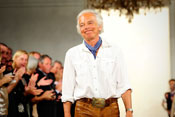
Photo: Emmanuel Dunand | AFP | Getty Images |
Market Cap: $11.9 billion
Ralph Lauren, the chief executive of Polo Ralph Lauren , established his company in 1967 as a line of men's ties and developed the company into a global fashion empire. Lauren's successful clothing line came from his unique, classic style that went against conventional fashion of the time.
According to the Ralph Lauren website, Lauren said, "I never went to fashion school—I was a young guy who had some style. I never imagined Polo would become what it is. I just followed my instincts."
With only a high school diploma in hand, Lauren followed his instincts. His decision to ditch college and focus on running his business lead to a series of breakthroughs in the fashion world, including the first shop-within-a-shop designer boutique for men in Bloomingdale's department store in 1969. Lauren continued to build his empire, expanding it to include women and children's fashion, fragrances, and home furnishings.
Today, Polo Ralph Lauren is one of the most successful fashion companies in the world.
Richard Branson
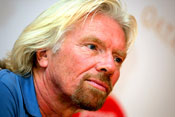
Photo: Karim Jaafar | AFP | Getty Images |
Company Worth: $18 billion
Virgin Media Market Cap: $8.1 billion
Forget graduating from college, this chief executive didn't even finish high school. Richard Branson, the current CEO of Virgin Group , dropped out of high school at age 16 to start Student Magazine . Four years later, Branson founded Virgin Group as a mail-order retailer. He opened his first record shop in London and two years later built Virgin's first recording studio. In 1977, Branson signed his first big name group, the Sex Pistols, and continued to sign popular artists such as the Rolling Stones and Culture Club.
In 1984, Branson developed Virgin Atlantic and the brand began to grow. Today, Virgin Group provides mobile, broadband, TV, radio, finance, health, tourism, leisure, and travel services.
Michael Dell
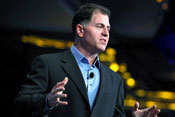
Photo: Justin Sullivan | Getty Images |
Market Cap: $30 billion
Most 19 year olds would spend a thousand dollars on a spring break weekend, or a put it toward buying a new car, but Michael Dell spent his $1,000 founding Dell .
The founder and CEO of Dell expanded his company with the idea that "technology is about enabling human potential." In 1992, he became the youngest chief executive to earn a ranking on Fortune magazine's "Fortune 500" list. His staff also grew from a one-man operation to 100,000 employees in just eight years.
Today, the company provides information-technology services for global corporations, governments, health care providers, small and medium businesses, education institutions, and home computing users.
Dell is not the only company this CEO has had a hand in creating. Dell founded MSD Capital in 1998 and a year later launched the Michael and Susan Dell Foundation, a philanthropic organization for global issues.
Bill Gates
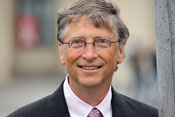
Photo: Sean Gallup | Getty Images |
Market Cap: $226.2 billion
College dropouts such as Mark Zuckerberg and Dustin Moskovitz are not the only successful business founders who attended, and then left, Harvard University.
Bill Gates, the founder of Microsoft , enrolled at Harvard as a freshman in 1973. Gates, who lived down the hall from Microsoft's current chief executive, Steve Ballmer, created BASIC, a programming language for the first microcomputer, during his first year of college.
Gates dropped out of Harvard in his junior year to concentrate all his efforts on a company he called Micro-soft with his childhood friend Paul Allen.
As if founding Microsoft wasn't enough, Gates went on to found Corbis , one of the world largest resources of visual information. He also earned a seat on the board of directors for Berkshire Hathaway , an investment company engaged in diverse business activity.
Steve Jobs
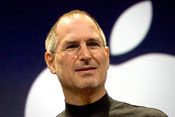
Photo: David Paul Morris | Getty Images |
Market Cap: $362.4 billion
As a young boy, this college dropout showed an early interest in computers.
When he was 12, Steve Jobs, the chief executive of Apple , called Bill Hewlett, co-founder of Hewlett Packard , after finding his number in the phonebook. When Hewlett answered, Jobs said, "Hi I'm Steve Jobs. I'm twelve years old and I'm a student in high school. I want to make a frequency counter. I was wondering if you had any spare parts I can have?"
Hewlett gave Jobs the spare parts and hired him that summer to work on the assembly line at his company. During this time, Jobs formed a friendship with Stephen Wozniak, a soon-to-be dropout from the University of California at Berkley.
Jobs enrolled at Reed College after high school, but he later dropped out. He connected once again with Wozniak and the pair quit their jobs to start production on a computer in Jobs' garage.
There are different versions of how the pair came up with the name for Apple. The best-known story comes from Jobs summer spent working on an apple orchard and his love for the fruit. The bite in the side of the apple is said to be a play on the computer term "byte."
In a biography, Jobs said he was worth more than $1 million when he was 23, $10 million when he was 24, and $100 million when he was 25.
Apple went from a garage-based operation to a multibillion-dollar, worldwide corporation, and it all started with two college dropouts tinkering in a garage.
Today, Gates serves as Microsoft's chairman and as an advisor on key development projects.


