Thursday, August 19, 2010

The most stupid Handball in Women Football ever (Germany-South Korea)
football - u20 - germany vs south korea 5:1
Wednesday, August 18, 2010
Rare Video Footage Surfaces Of Kanye West Rapping With Late Mother Donda West
A rare video clip titled "Like Son, Like Mother" has surfaced of Kanye West and his late mother Dr. Donda West, sitting and reminiscing about one of his old rap songs.
In the clip from 2003, Kanye's disposition is completely opposite of his larger-than-life hip-hop persona. Instead, as his mother speaks, he clings on to her every word, like an eager, unassuming student.
Donda, who died in November 2007 from complications during a plastic surgery procedure, is reminding her son about one of her favorite songs from his archives.
 "You know the one I always used to try to get you to do, Kanye, and you never did it?" she says, unable to recall the name of the song. But she could remember some of the lyrics, so she begins to rap them:
"I walked through the halls of the school/ And it's cool to be known for my rapping ability/But what about those who ain't got it like me?"
She can't remember all the lyrics, and hums through some of the song. Her demonstration helps Kanye remember the words.
"That's a good rhyme, right?" Kanye says, blushing.
"I said, 'Kanye keep on doing it'," Donda replies. "'That's a million dollars. Remember everything you would do I would say, 'That's a million dollars?'"
 Kanye picks up the song from the top, as Donda raps alongside him, more like a fellow MC in a cipher than a former chairwoman of Chicago State University's English department.
The clip makes it more evident why Kanye has written so many endearing lyrics about his mother. For his 2005 sophomore album, Late Registration, he featured the song "Hey Mama," an ode to Donda for taking care of him, never putting a boyfriend before him, and for supporting his decision to pursue his career in music.
 During his feature on Young Jeezy's "Put On," Kanye raps, "I lost the only girl in the world that know me best."
For his forthcoming album, Kanye has another track for Donda, "Mama's Boyfriends." On this one, a jealous 5-year-old Kanye wrecks havoc whenever Donda brings a boyfriend around.
The "Like Son, Like Mother" video captures their bond, her support and influence, and his humble gratitude for her interest.
It's a genuine parent/child moment that transcends the music.
Iris Scanners Create the Most Secure City in the World. Welcome, Big Brother

We've all seen and obsessively referenced Minority Report, Steven Spielberg's adaptation of Philip K. Dick's dystopian future, where the public is tracked everywhere they go, from shopping malls to work to mass transit to the privacy of their own homes. The technology is here. I've seen it myself. It's seen me, too, and scanned my irises.
Biometrics R&D firm Global Rainmakers Inc. (GRI) announced today that it is rolling out its iris scanning technology to create what it calls "the most secure city in the world." In a partnership with Leon -- one of the largest cities in Mexico, with a population of more than a million -- GRI will fill the city with eye-scanners. That will help law enforcement revolutionize the way we live -- not to mention marketers.
"In the future, whether it's entering your home, opening your car, entering your workspace, getting a pharmacy prescription refilled, or having your medical records pulled up, everything will come off that unique key that is your iris," says Jeff Carter, CDO of Global Rainmakers. Before coming to GRI, Carter headed a think tank partnership between Bank of America, Harvard, and MIT. "Every person, place, and thing on this planet will be connected [to the iris system] within the next 10 years," he says.
Leon is the first step. To implement the system, the city is creating a database of irises. Criminals will automatically be enrolled, their irises scanned once convicted. Law-abiding citizens will have the option to opt-in.
When these residents catch a train or bus, or take out money from an ATM, they will scan their irises, rather than swiping a metro or bank card. Police officers will monitor these scans and track the movements of watch-listed individuals. "Fraud, which is a $50 billion problem, will be completely eradicated," says Carter. Not even the "dead eyeballs" seen in Minority Report could trick the system, he says. "If you've been convicted of a crime, in essence, this will act as a digital scarlet letter. If you're a known shoplifter, for example, you won't be able to go into a store without being flagged. For others, boarding a plane will be impossible."
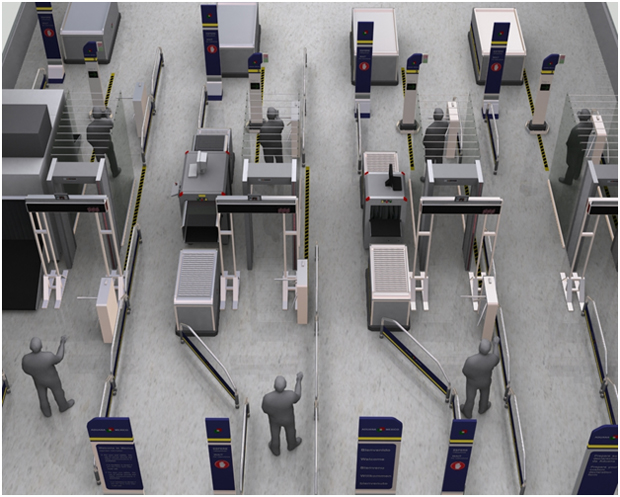
GRI's scanning devices are currently shipping to the city, where integration will begin with law enforcement facilities, security check-points, police stations, and detention areas. This first phase will cost less than $5 million. Phase II, which will roll out in the next three years, will focus more on commercial enterprises. Scanners will be placed in mass transit, medical centers and banks, among other public and private locations.
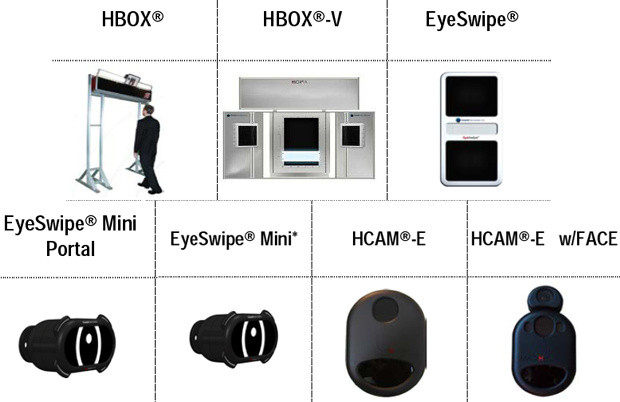
The devices range from large-scale scanners like the Hbox (shown in the airport-security prototype above), which can snap up to 50 people per minute in motion, to smaller scanners like the EyeSwipe and EyeSwipe Mini, which can capture the irises of between 15 to 30 people per minute.
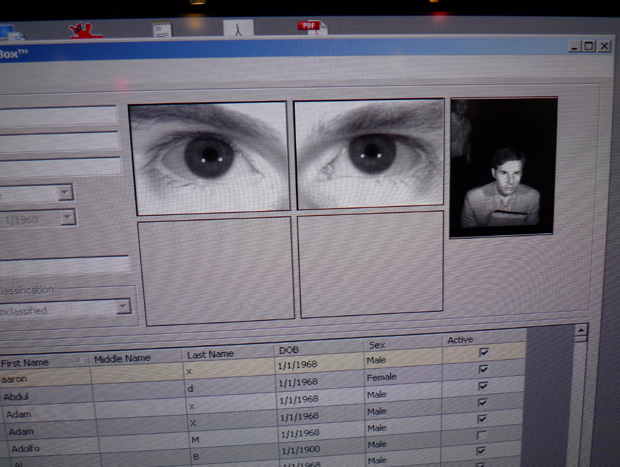
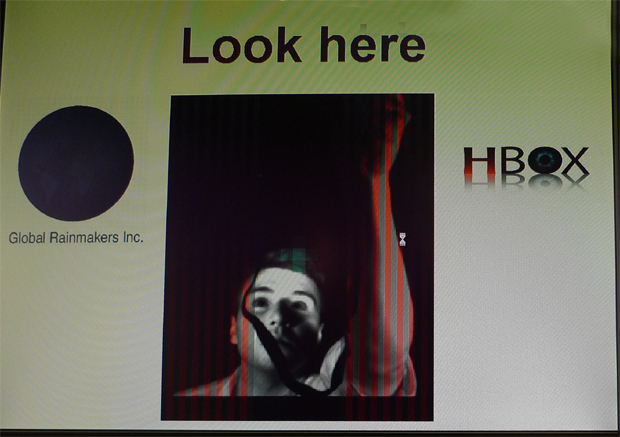
I tested these devices at GRI's R&D facilities in New York City last week. It took less than a second for my irises to be scanned and registered in the company's database. Every time I went through the scanners after that--even when running through (because everybody runs, right, Tom Cruise?) my eyes were scanned and identified correctly. (You can see me getting scanned on the Hbox in the video below. "Welcome Austin," the robotic voice chimes.)
For such a Big Brother-esque system, why would any law-abiding resident ever volunteer to scan their irises into a public database, and sacrifice their privacy? GRI hopes that the immediate value the system creates will alleviate any concern. "There's a lot of convenience to this--you'll have nothing to carry except your eyes," says Carter, claiming that consumers will no longer be carded at bars and liquor stores. And he has a warning for those thinking of opting out: "When you get masses of people opting-in, opting out does not help. Opting out actually puts more of a flag on you than just being part of the system. We believe everyone will opt-in."
This vision of the future eerily matches Minority Report, and GRI knows it. "Minority Report is one possible outcome," admits Carter. "I don't think that's our company's aim, but I think what we're going to see is an enviroment well beyond what you see in that movie--minus the precogs, of course."
When I asked Carter whether he felt the film was intended as a dystopian view of the future of privacy, he pointed out that much of our private life is already tracked by telecoms and banks, not to mention Facebook. "The banks already know more about what we do in our daily life--they know what we eat, where we go, what we purchase--our deepest secrets," he says. "We're not talking about anything different here--just a system that's good for all of us."
One potential benefit? Carter believes the system could be used to intermittently scan truck drivers on highways to make sure they haven't been on the road for too long.
GRI also predicts that iris scanners will help marketers. "Digital signage," for example, could enable advertisers to track behavior and emotion. "In ten years, you may just have one sensor that is literally able to identify hundreds of people in motion at a distance and determine their geo-location and their intent--you'll be able to see how many eyeballs looked at a billboard," Carter says. "You can start to track from the point a person is browsing on Google and finds something they want to purchase, to the point they cross the threshold in a Target or Walmart and actually make the purchase. You start to see the entire life cycle of marketing."
So will we live the future under iris scanners and constant Big Brother monitoring? According to Carter, eye scanners will soon be so cost-effective--between $50-$100 each--that in the not-too-distant future we'll have "billions and billions of sensors" across the globe.
Goodbye 2010. Hello 1984.
Santos Star Neymar In Hot Water For Insulting Referee On Twitter
The prodigy is alleged to have called a ref a 'thief' via the social networking site, and could face a spell on the sidelines...
By Daniel Edwards

The 18-year-old, who took no part in the game after picking up a knock midweek, allegedly posted the offensive message on his twitter page just after Meira had awarded a penalty against his side on the way to a 4-2 defeat. "This ref thief will leave in a police van", was the Brazil international's judgement on the penalty decision.
And Globoesporte report today that the comment could leave Neymar facing as much as a four match ban from the Brasileirao, as officials in the STJD took a dim view of his slur against Meira.
STJD Attorney General Paul Schmidt revealed that charges would be presented for the player to answer this Wednesday, to discover the story behind the comment. Neymar maintains that someone hacked into his account and left the message in his name.
"The matter arrived at our desks just yesterday," Schmidt told Redacao SporTV this afternoon in the committee's first comments on the issue.
"(Neymar) denies and says that there was a mistake... I want to believe one of the Brazilian Selecao did not write these idiotic things," the official continued.
Neymar could be charged with offending the honour of a match official, which under the new Brazilian code of sports justice carries a maximum four game ban if found guilty.
Tuesday, August 17, 2010
China Passes Japan as Second-Largest Economy
SHANGHAI — After three decades of spectacular growth, China passed Japan in the second quarter to become the world’s second-largest economy behind the United States, according to government figures released early Monday.
The milestone, though anticipated for some time, is the most striking evidence yet that China’s ascendance is for real and that the rest of the world will have to reckon with a new economic superpower.
The recognition came early Monday, when Tokyo said that Japan’s economy was valued at about $1.28 trillion in the second quarter, slightly below China’s $1.33 trillion. Japan’s economy grew 0.4 percent in the quarter, Tokyo said, substantially less than forecast. That weakness suggests that China’s economy will race past Japan’s for the full year.
Experts say unseating Japan — and in recent years passing Germany, France and Great Britain — underscores China’s growing clout and bolsters forecasts that China will pass the United States as the world’s biggest economy as early as 2030. America’s gross domestic product was about $14 trillion in 2009.
“This has enormous significance,” said Nicholas R. Lardy, an economist at the Peterson Institute for International Economics. “It reconfirms what’s been happening for the better part of a decade: China has been eclipsing Japan economically. For everyone in China’s region, they’re now the biggest trading partner rather than the U.S. or Japan.”
For Japan, whose economy has been stagnating for more than a decade, the figures reflect a decline in economic and political power. Japan has had the world’s second-largest economy for much of the last four decades, according to the World Bank. And during the 1980s, there was even talk about Japan’s economy some day overtaking that of the United States.
But while Japan’s economy is mature and its population quickly aging, China is in the throes of urbanization and is far from developed, analysts say, meaning it has a much lower standard of living, as well as a lot more room to grow. Just five years ago, China’s gross domestic product was about $2.3 trillion, about half of Japan’s.
This country has roughly the same land mass as the United States, but it is burdened with a fifth of the world’s population and insufficient resources.
Its per capita income is more on a par with those of impoverished nations like Algeria, El Salvador and Albania — which, along with China, are close to $3,600 — than that of the United States, where it is about $46,000.
Yet there is little disputing that under the direction of the Communist Party, China has begun to reshape the way the global economy functions by virtue of its growing dominance of trade, its huge hoard of foreign exchange reserves and United States government debt and its voracious appetite for oil, coal, iron ore and other natural resources.
China is already a major driver of global growth. The country’s leaders have grown more confident on the international stage and have begun to assert greater influence in Asia, Africa and Latin America, with things like special trade agreements and multibillion dollar resource deals.
“They’re exerting a lot of influence on the global economy and becoming dominant in Asia,” said Eswar S. Prasad, a professor of trade policy at Cornell and former head of the International Monetary Fund’s China division. “A lot of other economies in the region are essentially riding on China’s coat tails, and this is remarkable for an economy with a low per capita income.”
In Japan, the mood was one of resignation. Though increasingly eclipsed by Beijing on the world stage, Japan has benefited from a booming China, initially by businesses moving production there to take advantage of lower wages and, as local incomes have risen, by tapping a large and increasingly lucrative market for Japanese goods.
Beijing is also beginning to shape global dialogues on a range of issues, analysts said; for instance, last year it asserted that the dollar must be phased out as the world’s primary reserve currency.
And while the United States and the European Union are struggling to grow in the wake of the worst economic crisis in decades, China has continued to climb up the economic league tables by investing heavily in infrastructure and backing a $586 billion stimulus plan.
This year, although growth has begun to moderate a bit, China’s economy is forecast to expand about 10 percent — continuing a remarkable three-decade streak of double-digit growth.
“This is just the beginning,” said Wang Tao, an economist at UBS in Beijing. “China is still a developing country. So it has a lot of room to grow. And China has the biggest impact on commodity prices — in Russia, India, Australia and Latin America.”
There are huge challenges ahead, though. Economists say that China’s economy is too heavily dependent on exports and investment and that it needs to encourage greater domestic consumption — something China has struggled to do.
The country’s largely state-run banks have recently been criticized for lending far too aggressively in the last year while shifting some loans off their balance sheet to disguise lending and evade rules meant to curtail lending growth.
China is also locked in a fierce debate over its currency policy, with the United States, European Union and others accusing Beijing of keeping the Chinese currency, the renminbi, artificially low to bolster exports — leading to huge trade surpluses for China but major bilateral trade deficits for the United States and the European Union. China says that its currency is not substantially undervalued and that it is moving ahead with currency reform.
Regardless, China’s rapid growth suggests that it will continue to compete fiercely with the United States and Europe for natural resources but also offer big opportunities for companies eager to tap its market.
Although its economy is still only one-third the size of the American economy, China passed the United States last year to become the world’s largest market for passenger vehicles. China also passed Germany last year to become the world’s biggest exporter.
Global companies like Caterpillar, General Electric, General Motors and Siemens — as well as scores of others — are making a more aggressive push into China, in some cases moving research and development centers here.
Some analysts, though, say that while China is eager to assert itself as a financial and economic power — and to push its state companies to “go global” — it is reluctant to play a greater role in the debate over climate change or how to slow the growth of greenhouse gases.
China passed the United States in 2006 to become the world’s largest emitter of greenhouse gases, which scientists link to global warming. But China also has an ambitious program to cut the energy it uses for each unit of economic output by 20 percent by the end of 2010, compared to 2006.
Assessing what China’s newfound clout means, though, is complicated. While the country is still relatively poor per capita, it has an authoritarian government that is capable of taking decisive action — to stimulate the economy, build new projects and invest in specific industries.
That, Mr. Lardy at the Peterson Institute said, gives the country unusual power. “China is already the primary determiner of the price of virtually every major commodity,” he said. “And the Chinese government can be much more decisive in allocating resources in a way that other governments of this level of per capita income cannot.”
Source: Yahoo
Subscribe to:
Posts (Atom)